




Description
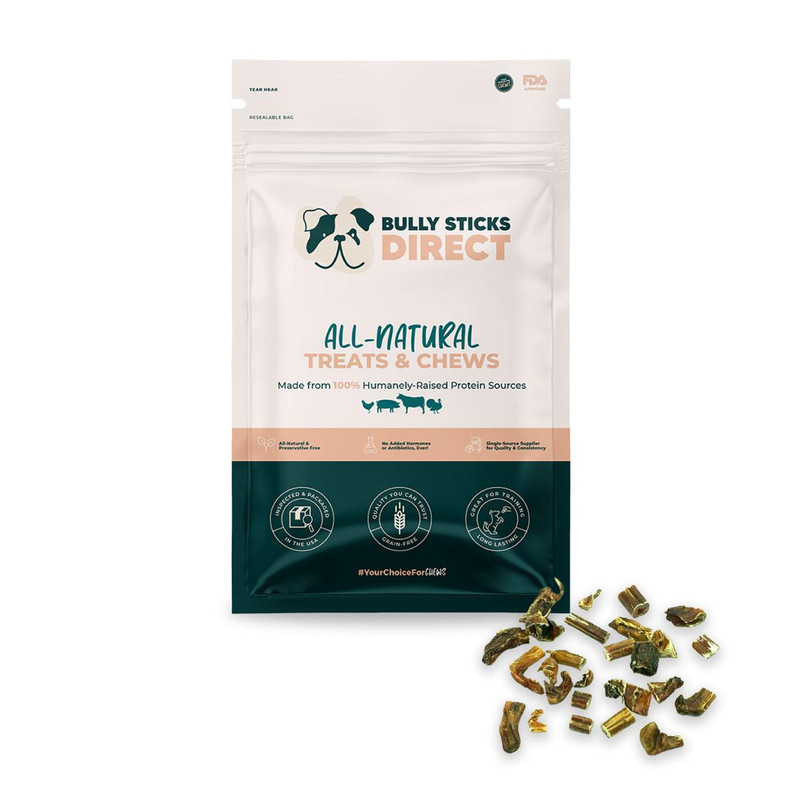
The 0.5–1.5" Bully Bites are the smallest bully stick format BSD makes — precision-cut to between half an inch and one and a half inches in length, selling approximately 500–800 individual pieces per pound. At this size, each piece contains approximately 5–15 calories. This is not a rounding-down estimate: at ~9–10 calories per gram, the smallest pieces at 0.5–0.75 grams produce 5–7 calorie rewards, and the largest pieces at 1–1.5 grams produce 10–15 calorie rewards. A pound bag gives a 5-lb Chihuahua roughly 30–100 days of single-piece treats, depending on piece size, or a full month of high-repetition training sessions at fragment-reward rates.
The case for this specific cut is anatomical before it is caloric. Toy breed dogs — Chihuahuas, Yorkshire Terriers, Toy Poodles, Maltese, Pomeranians, Toy Manchester Terriers, Papillons, Miniature Pinschers — have jaw structures scaled to their 3–8 lb body size. Their muzzle length is typically 2–4 cm. The width between their molars is often under 1 cm. A 2-3 inch bully bite, while short by any other standard, is still half the length of their entire head. The 0.5–1.5" micro bite is sized in proportion to their actual anatomy — small enough that they can position, hold, chew, and consume it at a pace appropriate for their jaw mechanics, without the physical awkwardness of a piece that extends beyond their comfortable grip.
This is also the puppy format. Puppy teeth begin to emerge at approximately 3–4 weeks, and adult teeth start replacing them from about 12–14 weeks. The window from 12 weeks to approximately 6 months is when puppies most benefit from chewing enrichment — chewing provides teething relief, endorphin release during a stressful developmental period, early positive associations with appropriate chew objects, and the foundational behavioral habit of "when I need to chew, I go to my chew item." The 0.5–1.5" micro bite is proportionally and calorically appropriate for this developmental stage in a way that no larger bully format is.
The calorie math that makes this format unique — and why toy breed owners need to run it: A 5-lb Chihuahua's daily caloric maintenance is approximately 275–300 calories. The 10% treat guideline provides a 27–30-calorie treat budget per day. A single 0.5" micro bite at 5–7 calories leaves room for 4–5 additional reward events that day. A single standard 1–3" bully bite at 40–90 calories consumes 133–300% of the daily treat budget in one piece. For toy-breed owners who have tried giving their dogs bully sticks and either felt guilty about the calories or watched their dogs gain weight, the micro-bite format resolves the problem: same ingredient, same processing, calorie-appropriate piece size. The guilt is not irrational — a 90-calorie bully bite given to a 5-lb Chihuahua is the caloric equivalent of giving a 150-lb person a full cheeseburger as a daily treat. The micro bite is the correctly scaled portion.
Puppy Development Physiology — Why 12–20 Weeks Is the Critical Window for Chewing Introduction
Canine dental development follows a predictable sequence. Deciduous (baby) teeth emerge from approximately 3–6 weeks. Around 12 weeks, adult teeth begin to push through, resorbing the roots of deciduous teeth. This eruption process — which continues until approximately 6 months, when the last adult molar emerges — is uncomfortable. The pressure of emerging teeth creates gum inflammation, and the relief drive is strong. Puppies that don't have appropriate chewing outlets during this period self-select inappropriate targets, such as furniture, baseboards, shoes, and hands.
The 0.5–1.5" micro bite addresses this at the appropriate size and density. Hard enough to provide the counter-pressure that relieves teething discomfort. Soft enough (compared to antlers, Nylabone, or frozen raw bones) to avoid stressing deciduous teeth that are partially resorbed and more fragile than adult teeth. Short enough for a puppy's developing paw-hold capacity and jaw length. And at 5–15 calories per piece, proportional to a puppy's caloric needs during a growth phase where nutrition balance is critical, treats cannot be a significant fraction of daily calories without disrupting the protein-to-energy ratio needed for skeletal development.
The introduction of bully bites during the 12–20 week window also establishes the behavioral habit that prevents destructive chewing in adult dogs: when I have the urge to chew, I go to my designated chew item. Puppies that learn at 14 weeks that beef pizzle pieces appear when the urge to chew is directed to an appropriate object are building the foundational reward association that makes adult chewing behavior appropriate for years. The micro bite is the format in which this foundation is correctly built for toy breeds and small-breed puppies.
High-Repetition Training — The Operational Mathematics
For trainers working serious high-repetition sessions — 100, 150, or 200 reward events in a 20–30 minute block — treat calorie management as an operational constraint, not a wellness preference. Here is the math for the 0.5–1.5" micro bite at typical training use:
100-rep session, whole pieces at smallest size (~5–7 cal each): 500–700 training calories. For a 20-lb dog at ~600 cal/day, this is the entire daily calorie budget from treats alone — not practical for daily training use without severe meal restriction. Solution: fragment rewards. Break each piece into halves or thirds.
100-rep session, half-piece fragments at ~2.5–3.5 cal each: 250–350 training calories for a 20-lb dog. Still high for daily training. For intensive training protocols: use micro bites as jackpot markers (whole pieces, 3–5 per session for exceptional performance), and use your regular lower-calorie kibble as the standard repetition reward, switching to micro-bite fragments for high-value sequences. This tiered approach gives you the motivational boost of a high-value natural protein treat at the moments that matter most (new behavior acquisition, reliability challenges) without the caloric commitment of 100+ high-value pieces per session.
For toy breeds (5–8 lbs) at fragment size (~1–2 cal each): 100-rep session = 100–200 training calories. For a 5-lb Chihuahua at 275 cal/day, this is 36–73% of daily calories — feasible for a training-heavy day with a meal skip, but not sustainable daily. The micro bite at fragment size is the most calorie-efficient natural protein training treat available, but toy breed metabolic reality means calorie management even at this size requires attention.
Breed-Specific Use Cases — Toy Breeds. This Format Is Designed For
Chihuahuas (3–6 lbs): The 0.5–1.5" micro bite is proportionally correct for the smallest Chihuahua anatomy. Calorie budget: ~225–300 cal/day → 1 whole piece per day at 5–10 cal, or 5–8 fragment training rewards. Dental disease risk is among the highest of any breed — daily contact with even the smallest pizzle piece produces more weekly dental contact events than any full-size stick protocol at this weight class.
Yorkshire Terriers (5–7 lbs): Yorkies are highly trainable and respond well to high-value food rewards. The micro bite at 5–12 calories per piece allows training sessions that preserve motivation without exhausting the daily treat budget. Yorkies also have notorious dental disease issues — small jaw, crowded teeth, frequent early-onset periodontal problems. Daily micro bite use as a dental contact strategy is directly beneficial for this breed.
Toy Poodles and Miniature Poodles (4–12 lbs): Among the most trainable breeds. High-rep training with Toy and Mini Poodles is genuinely common — these dogs can execute 100+ clean repetitions in a session and benefit from precise reward calibration. Micro bites as jackpot markers for clean, fast, precise responses, with standard lower-value treats for repetition rewards, match the motivational hierarchy that reward-based Poodle training requires.
Maltese (5–7 lbs): Maltese are prone to hypoglycemia (low blood sugar), particularly when under-eating, a medical condition that makes calorie management in treats a genuine clinical variable. At 5–15 calories per piece, micro bites can be reliably included in the daily caloric accounting for Maltese without creating the accounting uncertainty that larger treats introduce.
Nutrition & Sourcing Specs
Nutrition Per Piece
| Crude Protein | ~86% |
| Calories per gram | ~9–10 |
| Calories per piece | ~5–15 (varies by cut) |
| Ingredients | Beef Pizzle Only |
| Grain-free | Yes |
| Pieces per lb | ~500–800 (natural variation) |
Sourcing & Processing
| Beef source | Grass-fed, free-range |
| Hormones/antibiotics | None |
| Processing | Extended oven-baked, odor-free |
| Chemical additives | None |
| Rawhide-free | Yes |
Frequently Asked Questions
From approximately 12 weeks, when adult teeth begin emerging. Before 12 weeks, puppies' deciduous teeth are the only teeth present, and the jaw and digestive systems are still at early stages of development. At 12 weeks, emerging adult teeth create teething pressure that chewing relieves, and the micro bite size is proportionally correct for this developmental stage. Always supervise completely — puppies at this age may attempt to gulp rather than chew, particularly in the first few sessions. Begin with a 5-minute supervised session, observe that the puppy is chewing rather than swallowing whole, and gradually extend the session length over the first 2 weeks. Remove pieces that are so soft they could be swallowed in a single attempt.
Same beef pizzle, same odor-free processing, same ~86% crude protein. The standard 1 lb Bully Bites contains pieces cut to 1–3 inches, giving approximately 150–300 pieces per bag at 40–90 calories each — appropriate for small-to-medium dogs 10–40 lbs and moderate training use. This product (0.5–1.5") is precision-cut to the smallest range: approximately 500–800 pieces per bag at 5–15 calories each. It is the correct format when piece size must be proportional to toy breed anatomy, when calorie-per-reward must be minimized for very small dogs, and when high-repetition training with 50–200 reward events per session requires the most calorie-efficient natural protein treat available.
Natural variation is inherent to any single-ingredient natural product. Beef pizzle from different animals has different natural thickness. The drying process produces color variation from tan to dark brown, depending on moisture content and surface exposure during baking. Cut precision gives a range of 0.5–1.5 inches rather than a single uniform length. None of this indicates quality variation — it is the normal characteristic of an unprocessed natural protein product, the same way beef jerky from a butcher varies in color and size while being uniformly high quality. The weight guarantee (1 pound) ensures you receive the correct quantity. Individual piece variation is the authentic mark of a real natural product.
Yes. BSD 0.5–1.5" Bully Bites contain one ingredient: beef pizzle. No chicken, no chicken by-product, no natural flavors that could be chicken-derived, no shared processing with chicken products. For dogs with confirmed chicken protein allergy — one of the most common canine food allergies — this is one of the cleanest high-palatability single-protein treats available. The training treat category is dominated by chicken-based products, making it difficult to find high-value, reliable-motivation treats for dogs with chicken allergies. Beef pizzle micro bites solve this at the palatability level, making training sessions work.
Instructions
Feeding Instructions :
Please monitor your dog while feeding these gourmet natural treats, they are fully digestible however, please always provide a fresh supply of drinking water for your pup.
Recommendations:
Store your bully sticks in the original zip lock bag under cool conditions