

Description
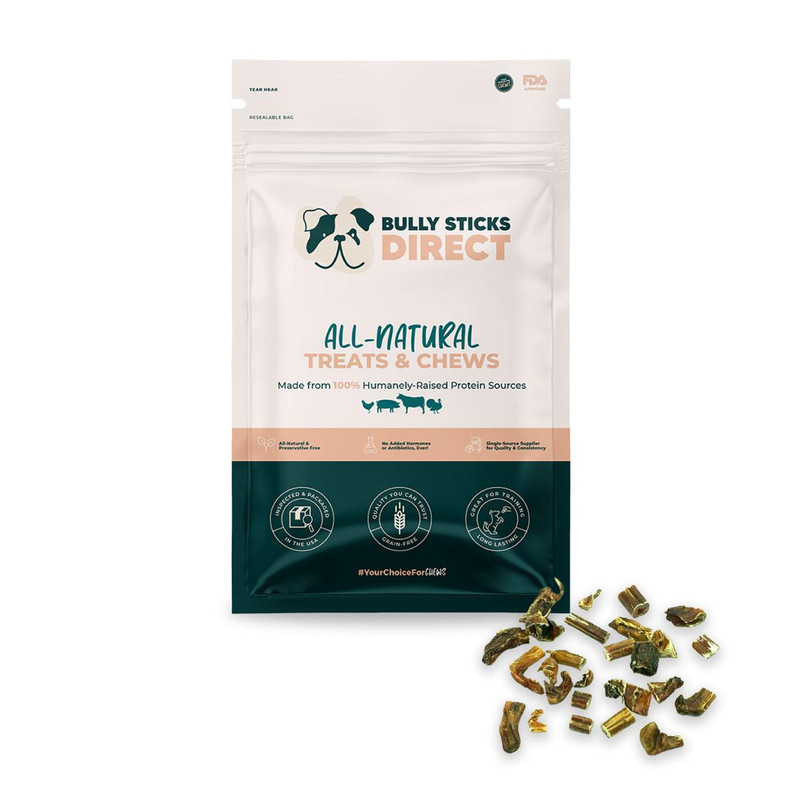
BSD Bully Bites are bully sticks cut into 1–3 inch pieces and sold by the pound. Everything that makes a BSD bully stick the highest-quality product in its category — grass-fed free-range beef pizzle, ~86% crude protein, no hormones, no antibiotics, no chemical additives, 100% digestible, extended oven-baked odor-free processing — exists identically in every piece in this bag. The format is different. The product is not.
The reason that format matters starts with what training treats actually are. Most commercial training treats — the soft cubes, the freeze-dried bites, the dehydrated pieces — contain between 4 and 8 ingredients. Primary protein, starch binder, natural flavors (which can be derived from any protein source), glycerin or glycerol to maintain moisture, and preservatives. For dogs undergoing elimination diet trials to identify food allergies, each of those secondary ingredients is a variable that the protocol cannot control. For dogs whose owners have moved to single-ingredient feeding philosophies, the training session becomes the daily exception where ingredient discipline collapses — because finding a single-ingredient training treat with the palatability to motivate 50 or 100 repetitions is genuinely difficult.
BSD Bully Bites are the solution. Single ingredient. Palatability that matches or exceeds commercial training treats for most dogs — beef pizzle is one of the highest-palatability proteins in the treat category, and the pieces' size and softening during use produce the textural cues that mark high-value rewards in canine motivation hierarchies. For trainers who need a single-ingredient reward that matches the motivational level of the best commercial treats, and for dog owners managing allergies, sensitivities, or elimination protocols, bully bites fill a category with very few options at this palatability level.
The ingredient audit every training treat buyer should run — and why bully bites win it: Take your current training treats and read the ingredient list aloud. Count the ingredients. Check for "natural flavors" — a category that legally permits any protein source, any plant extract, and synthetic compounds derived from natural materials, all under that single label. Check for glycerin, propylene glycol, or "humectants" that maintain softness. Check for "preserved with" anything. Now compare: BSD Bully Bites. Ingredients: beef pizzle. That is the entire list. Palatability is not achieved through flavor engineering — it is the natural result of ~86% crude protein from grass-fed beef at the highest available concentration in a single-ingredient treat format. For owners who read labels on their dogs' food, applying the same standard to the 30–100 treats given per training session is the logical next step. Bully bites are what that audit leads to.
The Behavioral Science of Chewing — Why Short Sessions Still Deliver the Full Benefit
Chewing is not primarily about entertainment for dogs. It is a neurochemical event. Sustained rhythmic jaw movement releases beta-endorphins — the same endogenous opioid peptides that produce runner's high in humans — and suppresses cortisol, the primary stress hormone. A 2020 study in PLOS ONE found that dogs given appropriate chewing opportunities exhibited significantly lower salivary cortisol levels in the 30 minutes following chewing sessions than during control periods without chewing enrichment. The calming effect is real, measurable, and dose-dependent on session time — but it begins within the first few minutes of sustained chewing.
For training use, this neurochemical context is directly relevant. Giving a dog a bully bite immediately before a demanding training session — not as a reward but as a primer — produces a calmer starting state. The mild cortisol suppression from even a 3–5 minute pre-session chew reduces the hyperarousal that impairs learning in high-drive dogs. Post-session, a bully bite as a jackpot reward extends the beta-endorphin release from successful task performance into the recovery period, reinforcing the positive association between training and reward at the neurochemical level. Most trainers who discover this approach independently describe the result as "better settling behavior after sessions," which is precisely what cortisol suppression and sustained beta-endorphin release produce.
Dental Health Through Frequency — The Small Dog Advantage of Bully Bites
The 2014 Rutgers University study by Lindsay Gallagher found that bully sticks reduced oral bacteria by 60.2% during a single session. The mechanism is mechanical abrasion: beef pizzle fibers in contact with tooth surfaces physically disrupt biofilm (plaque). For small dogs — Chihuahuas, Yorkies, French Bulldogs, Cavaliers, Toy Poodles, Miniature Dachshunds — this is the highest clinical priority in the entire category. Small breeds develop periodontal disease at disproportionately high rates due to jaw crowding that creates more plaque-accumulation surfaces per tooth. The American Veterinary Dental College estimates that 80% of all dogs have periodontal disease by age 3, with toy breeds typically affected earlier and more severely.
Bully bites enable a frequency-based dental strategy that full-size sticks cannot. A 6" stick given twice weekly = 2 dental contact sessions per week at ~80 calories per session. A 1-inch bully bite given daily = 7 dental contact sessions per week at ~15–20 calories per session — with similar total caloric contribution and substantially more frequent mechanical plaque disruption. For small dogs where daily tooth brushing is often resisted and annual dental cleanings under anesthesia carry elevated risk, the frequency advantage of daily bully bites as dental contact events is clinically meaningful. One small bite per day — properly calorie-managed — delivers more dental contact events per week than any full-size stick rotation.
Calorie Management — The Only Bully Format With Truly Predictable Per-Piece Calories
The 2006 Tufts Cummings School of Veterinary Medicine study found that a 6-inch bully stick contained an average of 88 calories. Still, it noted very high caloric variance between products because most brands sort by appearance rather than weight. A stick that looks thick but is airy and light contains far fewer calories than its visual appearance suggests. BSD weight-sorting eliminates this variance for full-size sticks — but bully bites go further: at ~9–10 calories per gram, any piece can be weighed with a basic kitchen scale to determine exact caloric contribution. Break a larger piece in half, and you have half the calories, not an estimate. This is the only bully stick format where a dog owner with a kitchen scale can manage training calories to within 5% accuracy — genuinely useful for dogs with medical weight management requirements, diabetic dogs where precise calorie tracking matters, and any owner whose veterinarian has told them to track treat calories with precision.
Breed-Specific Guide — Which Small Dogs Benefit Most from Bully Bites Format
Chihuahuas (4–8 lbs): The 1–3" size is proportionally correct for Chihuahua jaw geometry. Calorie budget: ~250–320 cal/day → 10% = 25–32 treat calories → 1 whole piece or 2–3 fragment rewards per day within budget. Dental disease risk is severe in this breed — daily bully bite contact is a genuine clinical investment.
Yorkshire Terriers (6–7 lbs): Same proportional sizing as Chihuahuas. Yorkies are typically motivated dogs — the palatability of beef pizzle at this concentration reliably outperforms commercial kibble-based training treats for Yorkie motivation, making training sessions more efficient with bully bites than with lower-value rewards.
French Bulldogs (20–28 lbs): For Frenchies, the 1–3" bully bite format is the appropriate training reward and short session chew. Their brachycephalic anatomy means longer chewing sessions are more physically demanding — bully bites given as 10–15 minute session chews or as training rewards avoid the sustained session demands of full-length sticks. The odor-free processing prevents the buildup of odors in Frenchie-occupied indoor spaces that natural scent bully sticks produce.
Cavalier King Charles Spaniels (12–18 lbs): Cavaliers are gentle chewers with elevated cardiac health requirements as they age. Bully bites at 1–3" are correctly sized for casual chewing, and the ability to manage calories to within 10% per piece keeps treat integration compatible with the careful dietary management often required for senior Cavaliers with mitral valve disease. Single-ingredient format also means no concerns about secondary ingredients when combining with cardiac medications that have dietary interaction profiles.
Miniature Schnauzers (10–18 lbs): Schnauzers are prone to hyperlipidemia (elevated blood triglycerides) — a condition that makes fat content in treats a genuine medical variable. Bully bites at ~86% protein / low fat are one of the safest natural treat options for this breed. The single-ingredient format eliminates fat-contributing secondary ingredients found in many commercial training treats.
How to Use — Training Protocol, Chew Sessions & Storage
As training rewards: Use whole pieces for jackpot rewards and high-value markers. Break into halves or thirds for standard repetition rewards in high-rep sessions. Keep in a sealed treat pouch during sessions — the odor-free processing prevents the strong smell that natural scent bully bites would create in a training pouch worn against the body for an hour.
As chew sessions for small dogs: Give 1 whole piece as a 10–20-minute chew session. Remove any piece that has been softened to the point where it could be swallowed in a single attempt. For dogs under 10 lbs, supervise the entire session — pieces that soften with saliva can become a swallowing risk if the dog attempts to gulp.
Frequency: Training use: as needed per session, managing total daily caloric contribution. Session chew use: 2–5 times per week, depending on dog size and calorie budget. At ~40–90 calories per whole piece, daily use for dogs under 15 lbs requires meal adjustment; for dogs 20+ lbs, a single piece per day falls within the 10% treat guideline without adjustment.
Storage: Seal immediately after each use. Airtight container or bag in a cool, dry location. After opening: 2–3 months. Do not refrigerate or freeze. Natural variation in color, texture, and exact piece size is expected and normal, same as any natural single-ingredient protein product.
Frequently Asked Questions
Bully bites are BSD bully sticks cut into 1–3 inch pieces and sold by the pound. Identical ingredient (beef pizzle only from grass-fed free-range cattle), identical processing (extended oven-baked odor-free), identical ~86% crude protein, and low-fat profile. The only variable is size — the short format makes them appropriate for training rewards, small-dog chew sessions, and high-frequency daily treat use, where a 6" or 12" stick would be proportionally too large or calorically too dense. At approximately 40–90 calories per whole piece versus 80–120 for a 6" Standard stick, bully bites give you roughly twice as many treat events per calorie spent on full-size sticks of equivalent weight, which is the economic and practical case for the format.
Yes, with calorie management. For a 50-repetition training session using whole 1-inch pieces at ~15–25 calories each: 750–1,250 calories for the training session. For most dogs, this substantially exceeds the appropriate treat budget for a training session. The correct approach for high-repetition sessions is to use fragment rewards: break each piece into 4–6 small fragments and use those fragments as the standard repetition reward, reserving whole pieces for jackpot markers or session-end rewards. At fragment size, 50 repetitions contribute 150–300 calories — more manageable within a daily treat budget. Reduce kibble on training days to maintain total daily caloric intake. The single-ingredient format means no concern about cumulative additive or preservative exposure from high-frequency use — a genuine concern with some commercial training treats given 100 times per week across multiple sessions.
Three reasons specific to single-ingredient training use. First: palatability. Beef pizzle at ~86% crude protein concentration is among the highest-palatability natural protein formats available — dogs that show inconsistent motivation with commercial grain-based training treats typically show reliable, strong motivation for beef pizzle pieces. Training effectiveness depends on reward consistency, and a treat that produces unpredictable motivation undermines session quality. Second: ingredient cleanliness. Commercial training treats typically contain 4–8+ ingredients, including natural flavors, humectants, and preservatives. For dogs on elimination-diet protocols, these secondary ingredients are considered protocol contaminants—third: nutritional alignment. If you've chosen a grain-free, single-ingredient feeding philosophy for your dog's primary diet, applying the same standard to 30–100 daily training treats is the nutritionally consistent position. Bully bites are the format used to execute it.
At ~9–10 calories per gram, any piece can be weighed on a basic kitchen scale to determine exact caloric contribution — this is the most precise calorie management available in any bully stick format. General daily framework: dogs 10–20 lbs have a treat budget of approximately 50–70 calories (10% of ~500–700 cal/day maintenance). That is 1 whole small piece or 3–4 fragment rewards per day within budget. Dogs 20–40 lbs have 80–130 calories of treat space — 1–2 whole pieces without meal adjustment. For dogs with medical weight management requirements, weigh the piece before giving and log against the day's calorie total. No other bully format allows this precision because full-size sticks have natural weight variance, making per-stick calorie estimation less accurate.
Both are the same grass-fed beef pizzle, processed odor-free. The standard 1 lb Bully Bites contains pieces up to 3 inches long, giving approximately 150–300 pieces per bag at 40–90 calories each. The 0.5–1.5" version is precision-cut to the smallest range in the lineup — approximately 500–800 pieces per bag at 5–15 calories each. Choose the standard version (this product) for small-to-medium dogs 10–40 lbs, where 1–3" pieces are appropriate for session chews and moderate-rep training. Choose the 0.5–1.5" version for toy breeds under 8 lbs, very young puppies, and high-repetition training sessions where minimum calorie-per-reward is the priority.
Yes — and the case for daily small-format bully stick contact is stronger for small dogs than any other group. The 2014 Rutgers study confirmed a 60.2% reduction in oral bacteria per bully stick session. For toy breeds with the highest periodontal disease rates in the canine population, daily bully bite contact provides 7 dental sessions per week at the caloric contribution of 2–3 sessions per week with a full 6" stick. The higher session frequency yields greater total weekly mechanical plaque disruption at an equivalent total caloric cost. Reduce kibble on days with bully bites to maintain calorie targets. This is not a substitute for annual veterinary dental examinations — but it is the most evidence-backed between-cleaning intervention for small dog dental health, with a treats-level caloric contribution.
Instructions
Feeding Instructions :
Please monitor your dog while feeding these gourmet natural treats, they are fully digestible however, please always provide a fresh supply of drinking water for your pup.
Recommendations:
Store your bully sticks in the original zip lock bag under cool conditions