

Description
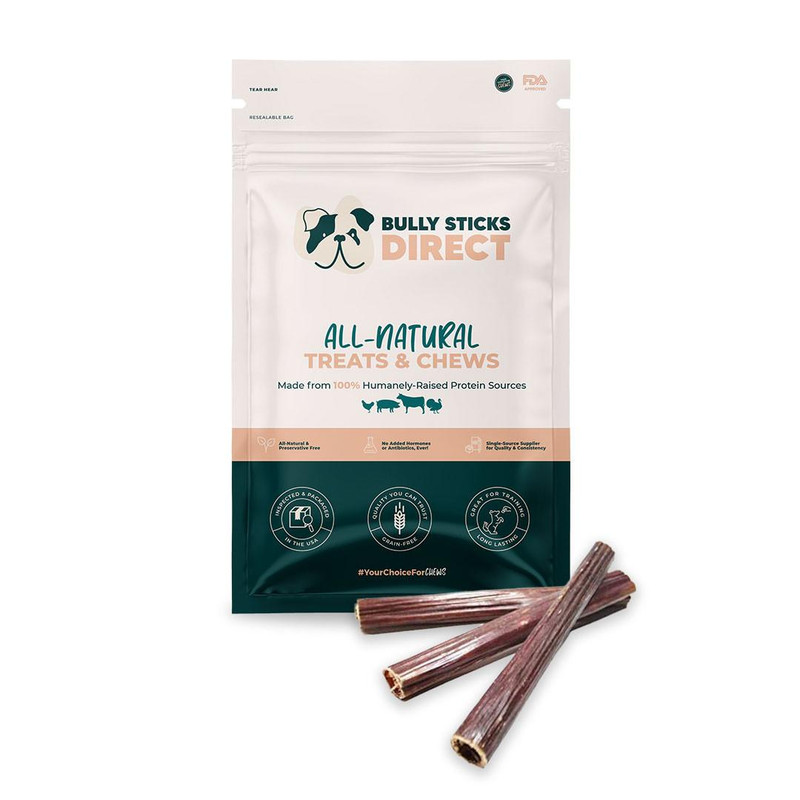
BSD's 6" Bladder Sticks, sold by the pound, are 100% beef bladder in the 6" format, sold in bulk for extended rotation use. The 6" length produces 18–35 minute sessions for small-to-medium dogs under 55 lbs — the session range is appropriate for daily primary enrichment in the small breed slot or moderate rotation use in the medium breed slot. The beef bladder is smooth muscle organ tissue from the urinary bladder of cattle — anatomically distinct from the striated pizzle muscle of bully sticks, compositionally different in its amino acid ratio and trace mineral concentration, and representing a tissue-type contribution to the daily treat rotation that no amount of additional bully sticks can replicate. Sold by the pound rather than by piece count, the bulk format provides per-piece economics appropriate for the committed-rotation user who distributes bladder sticks across a weekly beef-tissue variety protocol.
The bulk format serves two specific user types: multi-dog households and single-dog owners with high rotation frequency. For a three-dog household where each dog receives bladder stick sessions twice weekly, a pound of 6" bladder sticks provides approximately 2–3 weeks of rotation supply — a meaningful bulk value over individual unit purchasing. For single-dog owners running a complete five-tissue weekly rotation (pizzle, bladder, corium, esophagus, gastric mucosa), a pound of 6" bladder sticks represents the Tuesday/Thursday slots for 6–8 weeks at typical usage rates, making bulk purchasing the practical approach for committed rotation protocols.
The 6" size serves small dogs under 20 lbs as a full primary enrichment session format — 28–35 minute sessions for tiny breeds receiving the organ tissue variety they benefit from as much as large breeds, but in proportion to their size. For medium dogs 25–55 lbs, the 6" bladder stick produces shorter sessions (18–26 minutes), appropriate as a rotation component rather than the primary daily enrichment chew — medium dogs needing full sessions can pair two sticks or use the 6" bladder sticks as the shorter-session variety slot. At the same time, 12" formats cover the primary session days.
Why bulk matters for a rotation protocol — and how the pound format changes the economics: Rotation protocols only deliver their nutritional diversity benefit when they are actually executed consistently. The single most common reason owners abandon rotation protocols is logistics friction: running out of one product mid-week, making ad hoc purchasing decisions under time pressure, or finding that the per-piece cost of variety products makes daily rotation feel expensive. The pound format for 6" bladder sticks solves the logistics problem for the small-to-medium dog rotation user: one purchase covers 6–8 weeks of twice-weekly bladder stick sessions, meaning the bladder tissue slot in the rotation is stocked and available without active management. Consistent rotation requires bulk purchasing of rotation components; bulk purchasing requires that each tissue-type component be available in bulk. The 1 lb bag of 6" bladder sticks is that format for the organ smooth muscle slot in a small-to-medium dog rotation protocol.
Small Dog Applications — The 6" Bladder Stick as Primary Enrichment Format
For small dogs under 20 lbs, the 6" bladder stick is the primary long-session enrichment format in the organ tissue slot — comparable in role to the 12" bladder stick for large dogs, sized appropriately for smaller jaw anatomy and daily treat caloric management at small dog body weights.
Dachshunds (standard 16–32 lbs; miniature 8–11 lbs) — Dachshunds benefit from beef tissue variety rotation alongside their specific connective tissue support needs. The 6" bladder stick provides the organ smooth muscle variety slot for Dachshunds that are already receiving 6" gullet sticks for chondroitin and 6" collagen sticks for type I collagen in their rotation. Standard Dachshunds produce 22–30 minute sessions on a 6" bladder stick; miniature Dachshunds produce 28–35 minute sessions — a full enrichment session for small body mass at the appropriate length.
French Bulldogs (20–28 lbs) — Frenchies with food sensitivity benefit from the clean single-ingredient beef bladder profile — no additives, no processing agents — appropriate for Frenchies managed on dietary sensitivity protocols where ingredient transparency is a daily requirement. The moderate texture of beef bladder (softer than bully sticks) is also appropriate for Frenchie jaw geometry, which sometimes struggles with the sustained resistance required to advance through dense dried pizzle.
Beagles (18–30 lbs) — Beagles are enthusiastic chewers that benefit from the organ tissue variety rotation. At 18–30 lbs, a 6" bladder stick produces 20–28 minute sessions — appropriate for a Beagle's moderate chewing intensity. Beagles that finish 6" bully sticks in under 15 minutes often produce longer sessions on 6" bladder sticks because the slightly different texture and scent engage their investigative chewing behavior differently than the familiar bully stick format.
Cavalier King Charles Spaniels (12–18 lbs) — Cavaliers on cardiac-sensitive dietary protocols benefit from the full single-ingredient transparency of beef bladder — 100% beef bladder with no secondary ingredients or additives means every component of the treat is known and accountable for Cavaliers managed by veterinarians tracking all dietary inputs.
Cocker Spaniels (20–30 lbs) — Cockers with food allergy history benefit from the organ tissue variety rotation that keeps any single beef tissue protein below the daily-repetitive-exposure threshold. A Cocker receiving 6" bully sticks on some days and 6" bladder sticks on other days has reduced daily pizzle tissue exposure compared to a Cocker receiving bully sticks exclusively.
How Many 6" Bladder Sticks Are in a Pound
Approximately 12–20 individual sticks per pound, depending on natural thickness variation within the production batch. Bladder wall thickness varies across individual animals — some sticks are thicker (fewer per pound, longer session per stick) and some are thinner (more per pound, shorter session per stick). This natural variation is characteristic of all whole-organ single-ingredient products and is not a quality inconsistency. The pound bag is sold by weight because the piece count is not standardizable for naturally varying whole-organ tissue.
For rotation planning, assume approximately 15 sticks per pound as a planning baseline. For a single small dog using a twice-weekly bladder stick, one pound lasts approximately 7–8 weeks. For a multi-dog household with two small dogs each receiving weekly bladder stick sessions, one pound lasts approximately 7 weeks.
Session Duration by Dog Size
| Dog Weight | Chewer Type | Est. Session | Notes |
|---|---|---|---|
| Under 10 lbs | Light–Moderate | 28–35 min | Full daily enrichment session for tiny breeds |
| 10–20 lbs | Moderate | 24–32 min | Primary small dog format |
| 20–35 lbs | Moderate | 20–28 min | Good rotation component |
| 35–55 lbs | Moderate | 18–24 min | Short rotation session; 12" for longer |
| Any | Aggressive | 10–18 min | Rotation component; combine with longer formats |
Frequently Asked Questions
Natural single-ingredient organ tissue products cannot be standardized to consistent piece counts because the thickness and weight of each piece vary across individual animals in the supply chain. Bladder wall thickness differs between animals based on breed, age, and individual anatomy — the same 6" length cut from different animals produces pieces ranging from thin-walled lighter sticks to thick-walled heavier sticks. Selling by the pound is the honest and accurate format for bulk natural organ products: the buyer receives a guaranteed weight of high-quality beef bladder, regardless of natural variation in piece-to-piece thickness. This is the standard format for bulk natural chews throughout the industry. For planning purposes: expect approximately 12–20 sticks per pound with natural variation. The range reflects the width of natural thickness variation in the product — some bags will run 18–20 thinner pieces, some will run 12–14 thicker pieces, all containing the same total pound of quality beef bladder.
Bladder sticks can re-engage habituation-fatigued bully stick users through two mechanisms: scent novelty and texture novelty. Beef bladder has a different scent profile than beef pizzle — both are beef products. Still, the organ tissue volatile compounds differ from striated muscle volatiles in ways that register as meaningfully novel to a dog whose nose has been calibrated to expect bully stick scent. The texture is also measurably different — slightly softer and more pliable than the firm, dense resistance of pizzle, which engages the dog's exploratory chewing behavior through a different tactile experience than the familiar bully stick. Most dogs that have lost enthusiasm for bully sticks show renewed interest in bladder sticks within the first session. The response is not guaranteed to last indefinitely. Eventually, the dog will habituate to bladder sticks, too, which is why the rotation protocol that cycles through multiple tissue types is the approach that sustains engagement long-term. Bladder sticks re-engaging bully stick habituation is the signal to expand the rotation, not to replace bully sticks with bladder sticks exclusively.
From 4–5 months onward with adult teeth beginning to establish, yes — the 6" bladder stick is appropriate for medium and large breed puppies with supervision. For small breed puppies under 8 lbs at 4–5 months, the 6" stick may be a somewhat large piece relative to the puppy's body size; monitor the first session to confirm the puppy is working the stick with paw-and-jaw coordination rather than attempting to swallow large sections. The moderate texture of bladder sticks — softer than bully sticks — is actually beneficial for the 4–6-month puppy phase, when deciduous teeth are giving way to permanent teeth and full adult jaw strength is not yet established. The bladder stick's resistance level sits between the softer texture of gullet sticks (which are appropriate from 3 months) and the firmer resistance of bully sticks (appropriate from 4–5 months) — making it an appropriate entry into the moderate-resistance chew category for puppies transitioning from soft-only formats to the full bully stick resistance level.
For two small dogs each receiving 6" bladder sticks twice weekly: plan the rotation around a stock-and-track approach. One pound of 6" bladder sticks at approximately 15 pieces per pound provides 15 stick sessions total — roughly 7.5 weeks of twice-weekly sessions per dog, or 3–4 weeks of twice-weekly sessions for both dogs combined. Keep one bag open at a time, store the sealed bags between sessions, and order the next bag when you have approximately 1 week of supply remaining. For the full rotation, designate Tuesday and Thursday as bladder-stick days for both dogs (or whichever two days fit your schedule). Monday and Friday receive bully sticks from the primary bully stick range; Wednesday receives a third beef tissue type (collagen or gullet, depending on your priority for joint support). Weekend sessions can alternate based on stock. One purchase per product category every 4–8 weeks provides the entire five-tissue rotation for two small dogs without daily management decisions — the rotation runs on a stock-replenishment cadence, not daily choices.
Any new food introduction can temporarily cause loose stool in dogs as the digestive system adjusts to a new protein source or tissue type — this is true of bladder sticks, bully sticks, gullet sticks, or any new chew. For dogs with established beef sensitivity (not a full beef allergy, but variable GI tolerance to beef products), introduce bladder sticks with 1 stick per first session, and observe for 24–48 hours before establishing a regular frequency. For dogs with healthy GI function receiving regular bully sticks without issue: the transition to beef bladder — same protein family, different tissue type — typically produces no GI disruption because the dog is already processing bovine proteins without difficulty. The risk of GI disruption is primarily relevant for: dogs being introduced to beef products for the first time, dogs with known GI sensitivity, and dogs receiving a sudden large quantity of any new food. Introduce bladder sticks into an established beef-based treat rotation gradually — starting with 1–2 sticks per week and building to the target rotation frequency over 2 weeks — and the risk of GI disruption is minimal for most dogs.
The caloric contribution of a 6" bladder stick is comparable to a 6" bully stick at similar weights — both are primarily dried protein with moderate fat content from beef organ and muscle tissue. The exact calorie count varies with natural production thickness: a thicker 6" bladder stick from the pound bag contributes more calories than a thinner one. As a working estimate, plan for approximately 50–80 calories per 6" bladder stick, covering the natural thickness variation in the pound bag. For small dogs where treat caloric contribution represents a meaningful percentage of daily intake — a 12 lb dog on 275 calories per day, where one 65-calorie bladder stick is roughly 24% of daily intake — reduce kibble slightly on bladder stick days to account for the contribution. This caloric management practice applies to all single-ingredient natural chews regardless of tissue type. It is the standard practice for small dog owners using natural chews as part of a calorie-tracked daily feeding protocol.
Instructions
Feeding Instructions :
Please monitor your dog while feeding these gourmet natural treats, they are fully digestible however, please always provide a fresh supply of drinking water for your pup.
Recommendations:
Store your bully sticks in the original zip lock bag under cool conditions