


Description
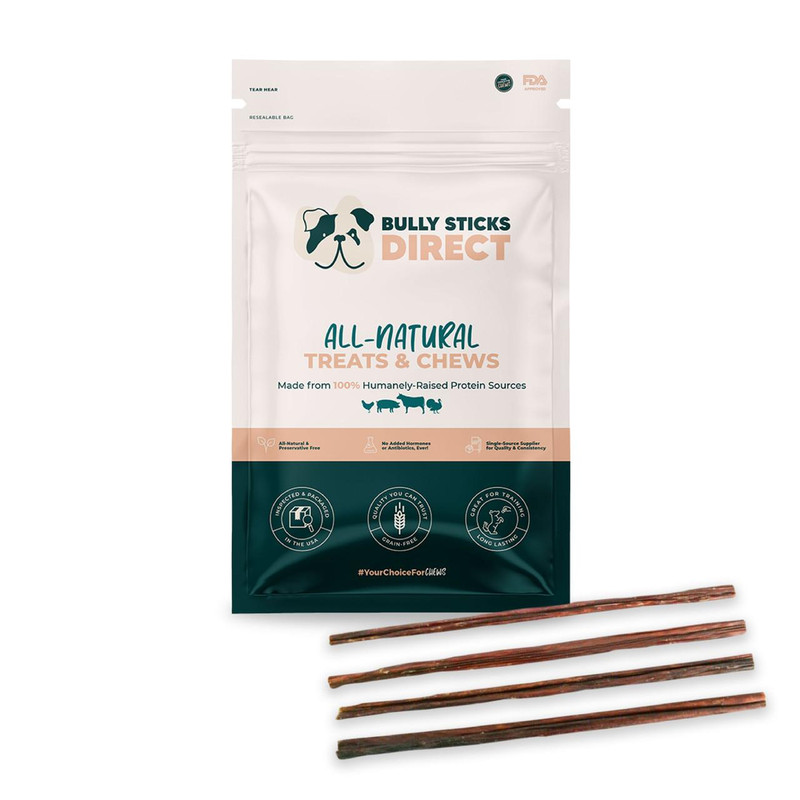
BSD's 6" Moo Taffy Sticks are 100% beef esophagus in the natural round form, 6 inches long, dried naturally without additives or chemical processing. The soft, pliable texture of beef esophagus — compressing under jaw pressure rather than requiring the sustained shearing force of dense dried pizzle — makes the 6" format the correct primary chew for three populations whose needs are often underserved by the hard-format dominated treat market: small breed senior dogs whose aging teeth and reduced jaw strength make conventional bully sticks uncomfortable, puppies between 3 and 6 months building jaw strength and chewing behavior during the teething window, and small-to-medium dogs of any age that engage more consistently with softer chew textures than with hard formats.
Small dogs are not exempt from joint disease. Dachshunds have the highest intervertebral disc disease (IVDD) rate of any breed — estimated at 19–24% of standard Dachshunds over their lifetimes — and IVDD involves degeneration of the glycosaminoglycan-rich spinal disc connective tissue in which chondroitin sulfate plays a direct structural role. French Bulldogs have elevated rates of hip dysplasia, given their brachycephalic morphology. Cavalier King Charles Spaniels have documented connective tissue considerations alongside their cardiac predisposition. Pugs, Boston Terriers, and Shih Tzus all carry breed-specific orthopedic concerns. The chondroitin sulfate naturally present in beef esophagus supports cartilage integrity and inhibits the enzymatic degradation of cartilage in osteoarthritis, regardless of whether the dog is a 100 lb Rottweiler or a 12 lb Dachshund. The 6" Moo Taffy Stick delivers this food-source chondroitin to small breeds in the size and softness format appropriate for their specific jaw profiles and dental status.
For puppies specifically, the 3–6-month teething window is the critical period for establishing the chewing behavior patterns that will define the dog's treat interactions for its entire life. Puppies that receive consistent, appropriate chewing outlets during teething develop focused, calm, productive chewing habits; puppies without appropriate outlets develop generalized, destructive chewing that redirects to furniture and household items. The 6" Moo Taffy Stick is appropriate from 3 months — the softer esophageal texture provides meaningful jaw resistance for developing puppy dentition without the hard force required by dense dried pizzle that could be too demanding for deciduous teeth. Supervised 15–25 minute sessions with the 6" Moo Taffy Stick during the teething window, which gives puppies an appropriate chewing target and begins the long-session chewing habit that will serve their behavioral welfare throughout adulthood.
The Dachshund case — why the 6" Moo Taffy Stick is specifically important for the highest-IVDD breed: Dachshunds are chondrodystrophic — their selective breeding for a long, low body has produced a skeletal structure where the intervertebral discs are prone to early calcification and herniation. IVDD affects an estimated 19–24% of standard Dachshunds over their lifetimes and is the leading cause of disability and euthanasia in the breed. Intervertebral discs are composed of the annulus fibrosus (outer ring, primarily type I collagen) and nucleus pulposus (inner gel, primarily type II collagen and proteoglycans including chondroitin sulfate). The glycosaminoglycan-rich connective tissue throughout the disc structure is the tissue that the beef esophagus specifically supports with naturally occurring chondroitin sulfate. For Dachshunds from age 3 onward — the age at which IVDD risk begins to accumulate meaningfully — consistent food-source chondroitin delivery via 6" Moo Taffy Stick sessions 2–3 times per week provides the specific building blocks relevant to disc connective tissue maintenance. This is not a treatment for diagnosed IVDD. Still, it is the most targeted nutritional support strategy available in treat form for the breed most affected by the condition, and chondroitin supports it.
The Puppy Protocol — 3 to 8 Months
The teething window creates three simultaneous needs: an appropriate outlet for the heightened chewing drive, a format gentle enough for developing deciduous and incoming permanent teeth, and a chewing experience that builds the paw-and-jaw coordination and focused engagement that makes the dog safe and reliable with chews throughout its life. The 6" Moo Taffy Stick addresses all three.
3–5 months (deciduous teeth, early teething): The soft esophageal texture is appropriate for early teething puppies whose deciduous teeth are not suited to hard-format resistance. Give in 15–20 minute fully supervised sessions. Remove when the remaining piece is small enough that the puppy could fit it entirely in its mouth — approximately 2" for small breed puppies, 2–3" for medium breed puppies at this stage. Most puppies at this age engage enthusiastically in the first session.
5–8 months (permanent teeth establishing): As permanent teeth come in and jaw strength develops, puppies can maintain engagement for longer sessions. The 6" Moo Taffy Stick remains the appropriate size for small breed puppies through this stage. Medium breed puppies transitioning from the 6" to the 12" format are appropriate from 6–8 months, as adult jaw strength is established. Large-breed puppies should transition to larger formats by 8–10 months, as adult body weight and jaw development require longer, denser formats.
Senior Small Dog Applications by Breed
Dachshunds (standard 16–32 lbs; miniature 8–11 lbs) — IVDD risk peaks from age 3–8. Standard Dachshunds on the 6" Moo Taffy Stick from age 3 onward receive consistent food-source chondroitin for disc connective tissue support throughout the highest-risk years. Miniature Dachshunds under 12 lbs benefit from the same product—the 6" format is appropriate for miniatures; supervise sessions and remove when the remaining piece reaches 2".
French Bulldogs (20–28 lbs) — Hip dysplasia affects an estimated 30–40% of French Bulldogs, and dental health in the breed is often complicated by their brachycephalic anatomy, producing crowded and maloccluded teeth. The soft texture of the 6" Moo Taffy Stick is appropriate for Frenchie jaw geometry, and the chondroitin contribution supports their elevated hip dysplasia risk. Always supervise French Bulldog chewing sessions completely.
Cavalier King Charles Spaniels (12–18 lbs) — Senior Cavaliers 8+ years managing mitral valve disease alongside orthopedic aging benefit from the clean single-ingredient profile of the 6" Moo Taffy Stick — no additives, no flavoring, no undisclosed secondary proteins — appropriate for dogs on cardiac-sensitive dietary protocols where ingredient transparency is a daily consideration.
Pugs and Boston Terriers (14–25 lbs) — Both breeds carry elevated rates of brachycephalic-related orthopedic concerns and benefit from the soft format that accommodates their specific jaw anatomy. The 6" format is appropriately sized for these compact breeds; supervise all sessions and remove at the 2–3" remaining point.
Session Duration by Dog Size
| Dog Weight | Chewer Type | Est. Session | Notes |
|---|---|---|---|
| Under 10 lbs | Light–Moderate | 28–38 min | Full session for tiny breeds; excellent |
| 10–20 lbs | Moderate | 22–32 min | Primary small dog soft-format chew |
| 20–35 lbs | Moderate | 18–26 min | Good rotation; 12" for longer sessions |
| Puppy 3–5mo | Developing | 15–22 min | Supervised only; remove at 2" remaining |
| Puppy 5–8mo | Developing | 18–28 min | Building sessions as jaw strength grows |
Frequently Asked Questions
Yes — 3 months is within the appropriate window for the 6" Moo Taffy Stick, and it is specifically well-suited to the teething phase. Teething puppies have a biologically driven chewing imperative that needs an appropriate outlet — the teething discomfort of incoming teeth creates oral sensitivity that chewing activity relieves. The absence of an appropriate outlet redirects this drive to whatever is available (furniture, baseboards, shoes). The 6" Moo Taffy Stick provides the chewing outlet with a soft texture appropriate for deciduous teeth and early jaw development. Give a completely supervised first session of up to 15 minutes at this age. Observe that the puppy is working the stick with paw-and-jaw coordination rather than attempting to bite off and swallow large sections. Remove when the remaining piece is approximately 2". Once the puppy demonstrates safe chewing behavior, the sessions can extend to 20 minutes. For very small breed puppies under 8 lbs at 3 months, the Moo Taffy Chips may be more appropriate than the full 6" stick due to the ratio of stick size to puppy mouth size at this age.
Discuss with your veterinarian — IVDD recovery timelines and activity restrictions vary significantly based on the severity of the episode, whether surgical or medical management was used, and the neurological status at each recovery stage. During the acute and early recovery phases, complete rest is typically required, and any chew that requires physical engagement or jaw effort may be contraindicated. After your veterinarian clears your Dachshund for gentle activity, the soft texture of the 6" Moo Taffy Stick is a gentler chewing activity than hard-format chews. It may be appropriate earlier in the recovery progression. Ask your veterinarian specifically about "soft chew sessions" during recovery check-ups. Once cleared, the 6" Moo Taffy Stick is an appropriate ongoing tool for the long-term IVDD management protocol: the food-source chondroitin supports disc connective tissue maintenance, and the soft texture avoids the hard jaw force that could stress recovering spinal structures.
For a small senior dog 8+ years old, the 6" Moo Taffy Stick is the better choice, specifically because of the texture. A 6" bully stick provides muscle protein and behavioral enrichment from a firm, dense format that requires sustained shearing force to advance through. For a senior small dog with worn teeth, gum recession, or reduced jaw strength, this resistance may make the bully stick uncomfortable, leading to sessions that are abandoned early or chewed halfheartedly. The 6" Moo Taffy Stick provides the same 6" stick format with a softer esophageal texture that compresses under reduced jaw force, allowing the senior dog to maintain a full 25–35 minute session rather than giving up at 10 minutes. The chondroitin content of the gullet stick is also relevant to a senior small dog's joint health — the bully stick provides muscle protein, which the senior dog also needs, so the ideal rotation uses both: bully sticks on other days and gullet stick 2–3 times per week for chondroitin delivery. If the dog can no longer manage the bully stick format, the gullet stick becomes the primary daily format, replacing it entirely.
The 6" Moo Taffy Stick is safe for French Bulldogs with the same supervision practices that apply to any chew for brachycephalic breeds. The soft, pliable texture of the esophageal tissue is more appropriate for Frenchies than hard-format chews because the progressive softening with saliva during the session allows the dog to work through it at a pace that does not require extended, high-effort jaw work, which could elevate respiratory demand. The primary safety consideration for Frenchies is not the product but the supervision: always watch completely throughout the session, as brachycephalic anatomy increases the risk of any chew-related complication. Remove the stick when it reaches 3" remaining — Frenchies, even more than other breeds, should not be left with a nub they might attempt to swallow in one gulp. With these practices in place, the 6" Moo Taffy Stick is one of the most appropriate long-session chews available for French Bulldogs specifically because of its soft texture.
For small dogs using gullet sticks as a chondroitin rotation component alongside bully sticks, 2–3 sessions per week is the appropriate rotation frequency. For small senior dogs in which the gullet has replaced harder chew formats as the primary daily chew, daily use is appropriate for most healthy small senior dogs without specific dietary restrictions. Caloric contribution: a 6" Moo Taffy Stick contributes approximately 40–70 calories per session, lower than a comparable 6" bully stick due to the lower fat content of the esophagus versus the pizzle. For a 12 lb small dog on a 250–300 calorie daily diet, this represents approximately 15–25% of daily calories — meaningful on the scale of small dog caloric management. Adjust kibble slightly on gullet stick days to account for the treat contribution. For puppies in the teething phase receiving the 6" Moo Taffy Stick daily during the 3–6 month window: daily use is appropriate, and the caloric contribution at this age fits within the higher-calorie puppy diet requirements without concern.
Yes — if your dog consistently engages more with flat treat formats than round stick formats, the 6" Moo Taffy Strip is the product to try first. Both contain 100% beef esophagus with identical chondroitin content per gram. The strip is cut flat from the esophagus wall into a ribbon form rather than retaining the natural round tubular shape. Dogs that tend to pin treats flat against the floor and work across the surface — rather than holding a round stick from one end — often engage more consistently and completely with the flat strip geometry. The first-session engagement test is the most reliable indicator: give the 6" Moo Taffy Stick in a supervised first session and observe whether the dog works it consistently from start to finish or abandons at the midpoint. If consistent, the stick is fine. If inconsistent, try the strip in a subsequent session and compare session completion rates. Most dogs accept both formats; the choice between them is purely about maximizing the individual dog's session engagement.
Instructions
Feeding Instructions :
Please monitor your dog while feeding these gourmet natural treats, they are fully digestible however, please always provide a fresh supply of drinking water for your pup.
Recommendations:
Store your bully sticks in the original zip lock bag under cool conditions