


Description
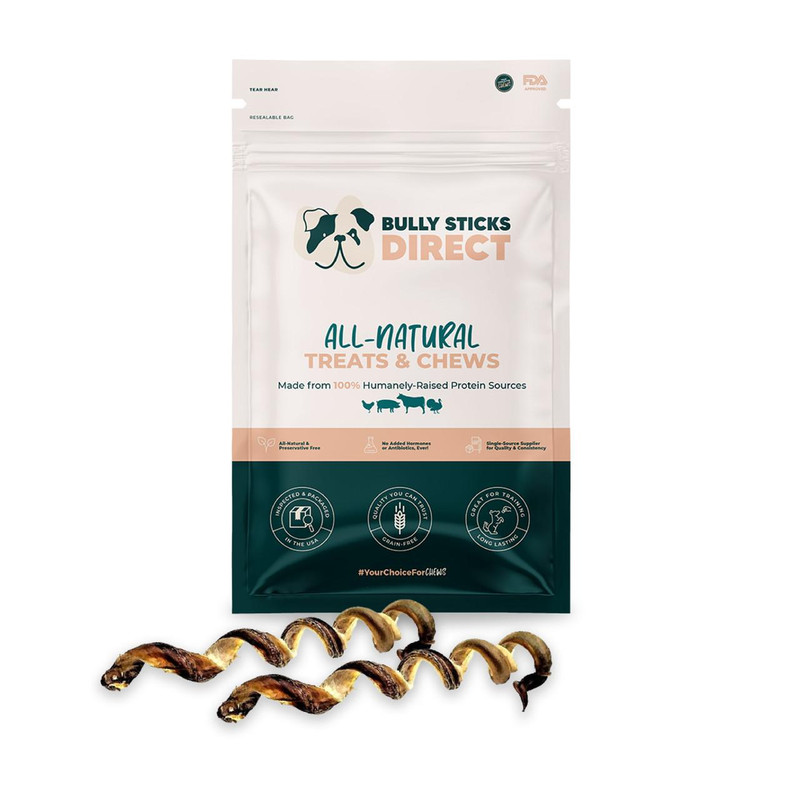
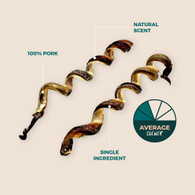
BSD's 6-7" Pork Bully Stick Springs are 100% pork pizzle — the dried pizzle of male pigs (Sus scrofa domesticus) — formed into a coiled spring shape during production, single ingredient, naturally dried, no additives or chemical processing. This is the only product in BSD's novel protein lineup that provides a true tissue-equivalent replacement for beef bully sticks. Goat skin is hide. Camel skin is hide. Turkey tendon is connective tissue. Pork pizzle is pizzle — the same anatomical tissue as a beef bully stick, from a biologically distinct protein source with no established cross-reactive allergen relationship with beef. For the approximately 3 million beef-allergic dogs in the United States — 34% of all confirmed food-allergic dogs per the BMC Veterinary Research systematic review — the pork pizzle spring is the single chew that closes the gap that every other novel protein option leaves open: the gap of a dog that has spent years learning to love the specific experience of working through dried pizzle muscle tissue, who now cannot have the beef that made that experience possible.
The novelty of pork for the typical commercial-diet dog is genuine and clinically meaningful. Pork does not appear in the top five most common canine food allergens — beef (34%), dairy (17%), chicken (15%), wheat (13%), and lamb (5%) — meaning pork is less commonly an allergen than every protein that saturates the commercial pet food market. Pork appears in some commercial kibble formulas, but at a dramatically lower prevalence than beef or chicken. For a dog that has eaten beef bully sticks and chicken training treats daily, pork pizzle represents a protein its immune system has had essentially zero prior exposure to. The transition from beef bully sticks to pork bully stick springs introduces a novel protein into the daily enrichment chew slot while preserving the tissue-type experience, the session duration, the behavioral enrichment mechanism, and the palatability profile that the beef bully stick had been providing.
The spring format extends sessions compared to straight pork pizzle sticks of equivalent weight by eliminating the clean single-plane shearing geometry that allows dogs to advance efficiently through straight sticks. The coil requires the dog to work from multiple angles as outer-spiral surfaces are consumed and inner-coil contacts emerge. This geometric complexity — extending the session through structural variation rather than material hardness — also restores engagement in dogs whose motivation for straight stick formats has declined due to habituated expectations. The spring shape is a novel physical problem the dog has not solved before, which drives renewed active engagement alongside the novelty of the protein.
The tissue-equivalent replacement argument — why pork pizzle is the most important novel protein chew BSD carries for beef-allergic bully stick users: Consider what a dog actually knows about a bully stick after six years of daily experience. It knows the shape — a long, round, dense stick that gets held with front paws and worked from one end. It knows the resistance — dense dried muscle tissue that requires a sustained shearing force and yields progressively. It knows the scent profile—the distinct, strong meat scent of dried pizzle that signals this specific category of high-value chew reward. It knows the session duration — 25–40 minutes in a settled location, producing the full cortisol-suppressing endorphin state that defines the bully stick session. When this dog is diagnosed with a beef allergy and transitions to goat skin, every one of these learned associations is disrupted — goat skin is hide, not muscle; it has a different texture, a different resistance profile, a different thickness geometry, and a different scent. The dog learns a new chew category from scratch. When this dog transitions to pork bully stick springs, none of the learned associations are disrupted, except the protein one. The pizzle tissue, the dense muscle resistance, the strong pizzle scent, the 20–35 minute session — all preserved. The protein changes from Bovidae to Suidae. The entire chewing experience remains continuous. For dogs with deep bully-stick behavioral investment, this continuity is the difference between a mere training session and a retraining process.
Pork Pizzle vs. Beef Bully Sticks — The Complete Novel Protein Comparison
| Variable | Pork Bully Stick Springs | Beef Bully Sticks (6") |
|---|---|---|
| Animal species | Sus scrofa domesticus (pig) | Bos taurus (bovine) |
| Biological family | Suidae | Bovidae |
| Tissue type | Pizzle (male urogenital) | Pizzle (male urogenital) |
| Allergen status | Not in top 5 canine allergens | #1 most common canine allergen (34%) |
| Cross-reactivity with beef | None established | IS beef |
| Format | Coiled spring — 6-7." | Straight stick — 6" or 12." |
| Protein profile | High protein from pizzle muscle | High protein from pizzle muscle |
| Texture/resistance | Dense dried muscle — comparable | Dense dried muscle |
| Session duration (60 lb dog) | 22–35 min (spring format) | 20–32 min (6" straight) |
| Appropriate for beef-allergic dogs | Yes (no pork allergy) | No |
| Novel protein rotation value | High | None — #1 allergen |
The Pork Novel Protein Science — Why Beef Allergy Does Not Predict Pork Intolerance
Food allergy is an IgE-mediated immune response to specific protein antigens. The antibodies developed in response to beef proteins are generated against the specific three-dimensional antigenic sites on bovine proteins — bovine serum albumin (BSA), bovine IgG, and the tropomyosin and myosin heavy chain isoforms specific to Bovidae musculature. These antigenic epitopes are species-specific at the biochemical level. Pork proteins — Sus scrofa serum albumin, porcine myosin heavy chain isoforms, porcine tropomyosin — present different three-dimensional antigenic surfaces from the corresponding bovine proteins, despite performing comparable biological functions in the animal's body.
The practical result: a dog's IgE antibodies that were generated in response to bovine protein antigens do not bind to porcine protein antigens with the same high affinity that produces an allergic response. There is no single universally accepted cross-reactive allergen between beef and pork proteins comparable to the MLC-1 cross-reactive allergen that links all poultry species. This is why veterinary dermatology literature and the major food allergy research studies (including the BMC Veterinary Research systematic review) treat beef allergy and pork allergy as distinct diagnoses rather than as a combined Bovidae/Suidae group. A dog allergic to beef is not predicted to be allergic to pork unless pork-specific sensitization has developed independently through prior pork exposure.
The critical caveat remains: some dogs do develop both beef and pork allergy through separate sensitization events, and some dogs react to pork through non-beef-cross-reactive pathways. This is why the supervised introduction protocol — 2–3 pieces in a first session, monitoring for 48–72 hours for adverse response before incorporating into the regular rotation — is essential for any individual dog being introduced to pork pizzle under a beef-free allergy management protocol.
The Spring Format Explained — Why Coiled Outperforms Straight for Sessions and Enrichment
BSD's pork pizzle is produced in the spring format — the pizzle is coiled into a tight spiral during the drying process. This is not a purely aesthetic choice. The spring format produces three functional improvements over straight sticks that are directly relevant to the enrichment and allergy management goals:
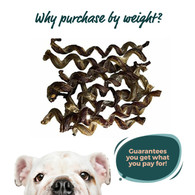
More pizzle per unit presentation length: A 6-7" spring contains more total pizzle material than a 6-7" straight stick because the coiling compresses the pizzle into a shorter linear footprint. The spring's 6-7" measurement reflects the compressed coil height, not the uncoiled length of the pizzle material. More material means more total jaw contact time, more protein delivery, and more of the dental abrasion accumulation that bully stick-class chews provide.
Session duration extension through geometric complexity: A straight stick presents a simple geometry — grip from one end, shear through the diameter, and advance. The dog can apply this pattern continuously and efficiently, consuming the stick at a pace reflecting its jaw power. The spring coil presents a self-renewing geometric challenge. As the outermost spiral layer is consumed, the next spiral inward presents at a different angle, requiring the dog to reposition and re-engage. The session naturally extends because the approach that worked for the previous section no longer works for the next section in quite the same way. For dogs where achieving longer individual sessions from a single piece is a goal, the spring format is more efficient per unit of product than the straight format.
Novel engagement restoring habituated motivation: Dogs become habituated to familiar formats. A dog that has received 6" straight bully sticks for three years approaches each new stick with a well-worn behavioral script — predictable engagement that delivers reliable enrichment but at declining novel motivational intensity. The spring format breaks this script: same tissue, same scent, completely different physical engagement problem. The spring restores the exploratory investigation and active problem-solving engagement that were present when the dog first encountered bully sticks years ago, before the format became completely predictable.
Breed-Specific Applications — The Six Breeds That Benefit Most
Labrador Retrievers (55–80 lbs) — Labs are BSD's most common large-dog customer, the most popular breed in America, and among the most food allergy-prone given their genetically elevated IgE antibody production. A beef-allergic Lab with a history of bully stick use transitioning to pork pizzle springs receives the closest possible tissue-equivalent novel protein replacement. The spring format's extended session (22–35 min for a 65 lb Lab) is comparable to the 6" beef bully stick sessions the Lab has been receiving. The protein is genuinely novel—the transition retraining behavioral retraining. Labs also have the POMC gene variant predisposing to obesity — factor the pizzle caloric contribution into daily intake and adjust kibble on pork spring days as you would on bully stick days.
Golden Retrievers (55–75 lbs) — Goldens share Labs' allergy predisposition profile and a history of bully stick consumption. Beef-allergic Goldens transitioning to pork pizzle springs benefit from the same seamless tissue-equivalent replacement. Goldens with DCM benefit from the single-ingredient, additive-free transparency of pork pizzle springs — no undisclosed secondary proteins, no added sodium, full ingredient clarity for owners managing sensitive cardiac protocols where every ingredient in every treat must be known.
German Shepherds (55–90 lbs) — Shepherds with beef allergy lose their primary long-session enrichment tool when the diagnosis is made. The behavioral welfare of Shepherds depends heavily on sustained enrichment — a breed with some of the highest mental stimulation requirements of any common dog that develops anxiety-driven, destructive behavior rapidly when enrichment routines are disrupted. Pork pizzle springs restore the enrichment session without a tissue-type disruption that would require re-establishing the behavioral routine from a different product category.
Boxers (55–70 lbs) — Boxers have elevated food allergy rates alongside their specific cardiac predisposition (arrhythmogenic right ventricular cardiomyopathy in Boxers). Beef-allergic Boxers on cardiac-managed protocols benefit specifically from pork pizzle springs' single-ingredient transparency — no "natural flavor" additives that could conceal secondary proteins or sodium — and full ingredient visibility for the cardiac dietary management context. The spring format's engaging novelty is also well-suited to the Boxer's characteristic active, playful chewing style.
West Highland White Terriers (15–22 lbs) — Westies are the breed most commonly presenting with beef-confirmed food-responsive dermatitis in veterinary dermatology practice. Beef-allergic Westies that have been bully stick users benefit from the pork pizzle spring as the transition that preserves the pizzle chewing experience they know, in the 6-7" format appropriate for a 15–22 lb dog. The spring produces 25–38 minute sessions for Westie-sized dogs — comparable to the 6" bully stick sessions the Westie was receiving before the beef diagnosis.
Miniature Schnauzers (13–20 lbs) — Schnauzers with food sensitivity, alongside their characteristic hyperlipidemia concerns, need novel protein treats with managed fat content. Pork pizzle fat content is comparable to beef pizzle — moderate, not the ultra-lean profile of turkey tendon at 5% fat. For Schnauzers with moderate fat restriction (not severe clinical restriction), pork pizzle springs are appropriate; for those with severe hyperlipidemia requiring strict fat restriction, turkey tendon sticks at 5% fat are the better choice. Confirm with your veterinarian which fat level applies to your Schnauzer's specific protocol before choosing between pork pizzle and turkey tendon as the novel protein enrichment chew.
The Novel Protein Rotation — Monthly Protocol With Pork
For owners using multiple BSD novel protein products in a structured monthly rotation to prevent sensitization buildup in any single protein, pork pizzle springs anchor the pizzle-tissue slot of the rotation — the weeks where the functional chewing experience is dense dried pizzle muscle tissue — while beef bully sticks cover that same slot in the beef-permitted weeks:
| Week | Enrichment Chew | Training Treat | Protein Family | Tissue Type |
|---|---|---|---|---|
| Week 1 | 6" or 12" Beef Bully Sticks | Turkey Tendon Strips | Bovidae / Meleagrididae | Pizzle / Tendon |
| Week 2 | Goat Skin or Camel Skin | Goose Cubes or Hearts | Capra / Camelidae + Anatidae | Hide / Organ |
| Week 3 | Pork Bully Stick Springs | Turkey Tendon Strips | Suidae / Meleagrididae | Pizzle / Tendon |
| Week 4 | Turkey Tendon Sticks | Goose Hearts or Strips | Meleagrididae + Anatidae | Tendon / Muscle |
This four-week rotation delivers: four distinct protein families (Bovidae, Capra/Camelidae, Suidae, Meleagrididae/Anatidae), three distinct tissue types (pizzle, hide, tendon/organ), and no single protein receiving more than one week of consecutive daily exposure. The pork pizzle spring specifically ensures that the pizzle-tissue enrichment chew slot is covered by two different proteins (beef and pork) in the rotation rather than relying on beef alone, which halves the weekly beef exposure through the highest-volume chew channel.
Session Duration by Dog Size
| Dog Weight | Chewer Type | Est. Session | Notes |
|---|---|---|---|
| Under 20 lbs | Light–Moderate | 30–42 min | Strong long session for small dogs |
| 20–40 lbs | Moderate | 25–38 min | Primary novel protein enrichment chew for medium dogs |
| 40–65 lbs | Moderate | 22–35 min | Comparable to a 6" bully stick session at this size |
| 65–90 lbs | Moderate | 18–28 min | Good session; give 2 for equivalent large dog enrichment |
| Any | Aggressive | 10–20 min | Use as a rotation component; combine with longer formats |
Safe Introduction Protocol
First introduction (any beef-allergic dog): Give 2–3 pieces in a fully supervised first session. Most dogs accept pork pizzle immediately — the natural pork scent is highly palatable to virtually all dogs regardless of prior protein history. Observe the session to confirm normal chewing behavior rather than attempts to gulp pieces whole. Monitor over the following 24–48 hours for any adverse response: GI upset (vomiting, loose stool), skin changes (itching, redness, hives), or any other unusual reaction. These responses would indicate pork sensitivity and should prompt withdrawal of the product and veterinary consultation.
Ongoing use: After a clean introduction, incorporate into the regular rotation at the frequency appropriate for your dog's management protocol — 2–5 days per week as the enrichment chew, potentially daily for dogs on complete beef-free protocols where pork is the primary pizzle-tissue replacement.
Storage: Seal the bag completely after every use. Cool, dry location away from humidity. Consume opened bags within 3–4 months. Natural scent product — the pork scent is strong and genuine; store sealed to prevent the spread of household odor if preferred.
Frequently Asked Questions
Almost certainly yes — and the transition is typically seamless compared to switching to a different tissue type. Your dog's seven years of bully stick experience have built a strong behavioral association with pizzle tissue: the specific scent, the dense, dried-muscle texture, the grip mechanics, and the session duration. Pork pizzle springs preserve every one of these associations except the protein. The natural pork scent is strong and highly palatable — dogs that have never had pork typically engage with it immediately in the first session. The coil spring shape may elicit a brief exploratory phase as the dog figures out the grip on an unfamiliar format. Still, pizzle tissue recognition typically overrides novelty from the format within the first minute. Present the spring in the same location you normally give bully sticks, in the same routine context. The first-session engagement rate for experienced bully stick dogs on pork pizzle springs is very high. Monitor the first session and the following 48 hours for any signs of pork sensitivity — the small percentage of beef-allergic dogs that also have pork sensitivity will respond at this introduction stage, which is why supervised monitoring of the first session is essential before making pork pizzle a daily routine item.
The spring shape is a functional production choice that produces measurably better sessions than equivalent-weight straight sticks. Three specific advantages: first, the coiled format contains more total pizzle material than a straight stick of the same nominal 6-7" presented height, because the coiling compresses more material into the same linear space. More material means longer total chewing time and more protein delivery per session. Second, the coil eliminates the clean single-plane geometry that allows dogs to advance through straight sticks efficiently — the multi-angle engagement required by the spring produces longer sessions than a straight piece of equivalent weight. Third, the spring format provides novelty for dogs habituated to straight bully sticks — the spring is a different physical problem that restores active exploratory engagement in dogs whose straight-stick motivation has become purely routine. If you prefer the straight stick format for any reason, BSD's standard straight beef bully sticks provide that geometry for dogs without beef allergy — but for dogs transitioning to pork, the spring format's session extension advantage makes it the better choice over a hypothetical straight pork pizzle product of the same weight.
Pork allergy is less common in dogs than beef, chicken, dairy, or wheat allergy — it does not appear in the top five most common canine food allergens per the BMC Veterinary Research systematic review. This lower prevalence reflects both lower commercial exposure frequency (pork is in fewer mainstream formulas than beef or chicken) and lower reported clinical sensitization rates at typical commercial exposure levels. For most dogs being introduced to pork pizzle for the first time, the allergy risk is lower than with additional beef or chicken exposure. The appropriate response to this relatively low risk is not zero precaution but proportionate precaution: a supervised first session with the pork pizzle spring and 48-hour monitoring, rather than either dismissing the risk entirely or treating pork as high-risk by default. If your dog has a known history of adverse reactions to pork-containing foods — any kibble or treat that lists pork or pork meal as an ingredient and produces symptoms — that is important information to share with your veterinarian before introducing pork pizzle. For dogs with no prior exposure to pork and a clean health history aside from a beef allergy, the supervised introduction protocol is appropriate, and the expected outcome is full acceptance without adverse response.
All three are appropriate novel protein chews for beef-allergic dogs — they serve different tissue-type functions, and the optimal protocol for most beef-allergic dogs uses all three in rotation rather than choosing only one. Pork bully stick springs provide the pizzle muscle tissue experience — dense dried muscle tissue at high protein, the direct functional equivalent of beef bully sticks, for dogs whose primary behavioral investment is in the pizzle-tissue chewing experience. Goat skin provides the hide-tissue experience — a leather-like texture from dried Capra skin, longer sessions due to hide density, and is appropriate for dogs that engage well with hide-format chews. Camel skin provides the most allergenically distant protein — Camelidae, no cross-reactivity with any common allergen — also in hide format, appropriate for dogs managing multiple allergen sensitivities, including both beef and chicken. The weekly rotation for a fully beef-free protocol: pork bully stick springs 2 days per week for pizzle enrichment, goat or camel skin 2 days per week for hide enrichment, turkey tendon sticks 1–2 days per week for lean tendon enrichment. This five-session rotation covers every enrichment function that beef bully sticks provide, distributed across four biologically distinct protein families, with no single novel protein receiving daily repetitive exposure that could drive new sensitization.
Yes — with your veterinarian's specific confirmation that pork is approved for your dog's protocol. For elimination diet trials targeting beef as the suspected allergen, pork is typically on the approved protein list — it is biologically distinct from beef with no cross-reactive allergen relationship, making it appropriate for a beef elimination protocol. The key requirements for elimination trial use: confirm with your veterinarian that pork is specifically approved for your dog's trial; use pork bully stick springs as the only enrichment chew during the trial (no beef bully sticks, no other chews containing beef or other excluded proteins); and apply the single-ingredient transparency benefit fully — pork pizzle springs contain 100% pork pizzle with no secondary ingredients, no "natural flavors," and no undisclosed proteins that could invalidate the elimination. One exposure to the excluded protein (beef) invalidates weeks of dietary restriction — the single-ingredient guarantee of pork pizzle springs eliminates the hidden-ingredient risk that commercial multi-ingredient treats carry. If your dog's elimination trial is specifically designed to test pork as a suspected allergen (rather than beef), pork pizzle springs are not appropriate during the trial period. Confirm the specific suspected allergen with your veterinarian before using any protein-based treat during a formal elimination diet trial.
For a beef-allergic Lab using pork pizzle springs as the primary replacement for daily bully sticks, 4–7 sessions per week (daily or near-daily) is appropriate for a healthy adult Lab without additional fat-management concerns. Each spring contributes approximately 120–180 calories, depending on production variation, comparable to a 6" beef bully stick's caloric contribution. Labs with the POMC gene variant predisposing to obesity need this calorie contribution factored into daily intake: reduce kibble by approximately 10–15% on days when the pork spring is given. For Labs on concurrent weight management alongside beef allergy management: 2–3 pork springs per week alongside turkey tendon sticks on other days provides the enrichment session frequency the Lab needs at a combined caloric profile that stays within weight management parameters (turkey tendon sticks at 5% fat contribute fewer calories per session than pork pizzle springs). For Labs in active protein rotation with no weight-management concerns, daily use of pork spring is nutritionally appropriate. It provides the daily enrichment session frequency that the breed's high behavioral needs require.
Instructions
Feeding Instructions :
Please monitor your dog while feeding these gourmet natural treats, they are fully digestible however, please always provide a fresh supply of drinking water for your pup.
Recommendations:
Store your bully sticks in the original zip lock bag under cool conditions