

Description
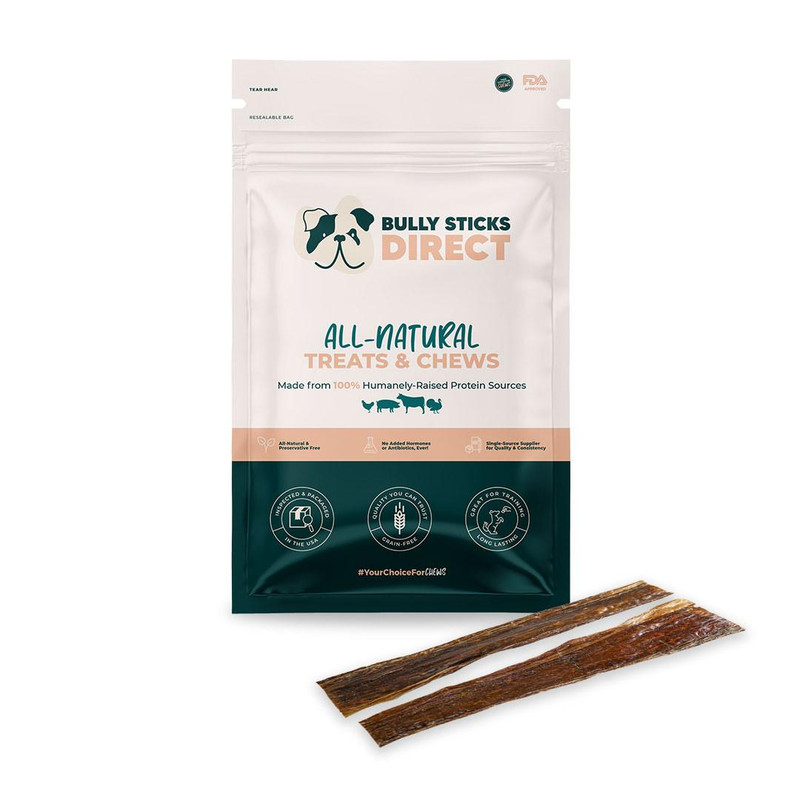
BSD's 12" Moo Taffy Strips are 100% beef esophagus cut flat from the esophageal wall into a ribbon form — the same ingredient as the 12" Moo Taffy Sticks, the same soft, pliable texture, the same naturally occurring chondroitin sulfate content, in a flat, wide geometry that changes how the dog interacts with the chew. The strip lies flat rather than presenting as a round tube — a wide, flat surface that some large dogs grip and work across its width more naturally than they work a round stick held from one end. For large senior dogs that have been inconsistent with the round stick format — working through it confidently for 15 minutes, then abandoning before the session is half complete — the flat strip format resolves this by changing the engagement geometry to one that works better with their specific chewing style.
The nutritional case is identical to the round stick format. Beef esophagus contains naturally occurring chondroitin sulfate in its glycosaminoglycan-rich submucosal connective tissue. Chondroitin sulfate inhibits matrix metalloproteinases (MMPs) and aggrecanases that degrade articular cartilage in osteoarthritis — the core mechanism of the most commonly prescribed veterinary joint supplement category. Approximately 18–22 million dogs in America have some degree of osteoarthritis, with a prevalence of approximately 80% in dogs over age 8. Large-breed senior dogs — Labs, Goldens, German Shepherds, Rottweilers — represent the highest-needs population for chondroitin delivery that is reliably consumed. The 12" Moo Taffy Strip provides that delivery in the flat format that maximizes session completion for dogs where round stick engagement is inconsistent.
The format choice between strip and stick is the one decision that matters for this product specifically. If your large dog consistently completes the round 12" Moo Taffy Stick from start to finish, the stick format is appropriate, and no format change is needed. If your dog works through the round stick inconsistently — strong initial engagement, followed by partial abandonment before the session ends — the flat strip geometry is the correct adjustment. Both formats produce equivalent chondroitin delivery per gram consumed. Maximizing session completion maximizes chondroitin delivery. The strip format is the tool that maximizes completion for flat-preference large dogs.
Why format preference matters clinically for chondroitin delivery: Chondroitin from beef esophagus is only delivered while the dog is actively chewing the product. A 12" Moo Taffy Stick that a large dog works through completely provides more total chondroitin per session than the same stick abandoned at 50% completion. For large dogs receiving gullet specifically for joint support, session completion rate directly determines the consistency of chondroitin delivery. An owner who notices their large dog consistently abandons the round stick format at the 50% mark — and switches to the flat strip format, producing consistent full sessions — has effectively doubled their dog's chondroitin delivery per session without changing any other aspect of the protocol. Format optimization is not a minor preference issue; for the joint support application, specifically, the session completion variable determines whether the protocol is working as intended.
12" Strip vs. 12" Stick — Choosing the Right Format for Your Large Dog
| Variable | 12" Moo Taffy Strip (Flat) | 12" Moo Taffy Stick (Round) |
|---|---|---|
| Form | Flat ribbon — wider, thinner | Round tube — narrower, deeper |
| Grip style favored | Pin flat to the floor, work across the width | Hold from one end, advance progressively |
| Best for dogs that | Work flat treats across the surface | Are habituated to the bully stick format |
| Chondroitin content per gram | Identical | Identical |
| Session (70 lb dog) | 25–45 min | 28–48 min |
| Recommended start format | If a dog prefers flat treats historically | If the dog is an experienced bully stick user |
The practical decision framework: if your large dog has been on bully sticks for years and handles round stick formats consistently, start with the 12" Moo Taffy Stick. If the round stick format produces inconsistent session completion, try the strip. If your large dog has primarily received flat jerky, flat treats, or flat-format chews in the past and has never been a strong round-stick user, start with the strip. Keep both in rotation once you know your dog's preference — variety enrichment through format alternation maintains engagement with the soft gullet category better than exclusive use of a single format.
The Senior Large Dog Application — Why Format Matters More in Senior Years
Senior dogs develop chewing style adaptations as their jaw strength and dental integrity decline. A dog that held bully sticks firmly from one end and advanced from tip to base for its entire adult life may, at age 9, with worn teeth and reduced jaw strength, find this vertical grip geometry increasingly awkward. The flat strip format lies horizontally — the dog presses it against the floor and works across its width rather than gripping vertically, which requires less sustained grip strength and jaw elevation to maintain. This is not a significant distinction for younger, dentally healthy dogs. For senior dogs where subtle jaw strength reduction has made the round stick format harder to maintain grip on throughout a full session, the flat strip format can restore session completion from the same ingredient in a more accessible geometry.
Session Duration by Dog Size
| Dog Weight | Chewer Type | Est. Session | Notes |
|---|---|---|---|
| 30–50 lbs | Moderate | 35–48 min | Strong session for medium dogs |
| 50–70 lbs | Moderate | 28–42 min | Good primary format for this range |
| 70–90 lbs | Moderate | 25–38 min | Good fit; braided for a longer duration |
| Any large | Aggressive | 12–22 min | Use a braided gullet for extended sessions |
Frequently Asked Questions
Yes — inconsistent session completion with round sticks in a senior Golden is the clearest indicator to try the flat strip format. A Golden that sometimes completes and sometimes abandons a round stick is telling you that the round geometry is working for her on good days (when jaw comfort and positioning are favorable) and failing her on other days (when jaw fatigue or positioning is suboptimal). The flat strip format removes the vertical gripping requirement that becomes inconsistent in senior dogs and replaces it with a horizontal surface on which the dog can work against the floor. In most cases, a senior Golden that finishes 50–60% of sessions on the round stick will finish 85–95% of sessions on the flat strip. That improvement in session completion rate directly improves consistency in chondroitin delivery, which is the clinical goal for a senior Golden receiving a gullet for joint support. Introduce the strip in a supervised session and monitor whether she works through it more thoroughly than she did with the stick.
Yes — the chondroitin sulfate in beef esophagus is present in the glycosaminoglycan-rich submucosal connective tissue throughout the esophageal wall, distributed through the tissue regardless of whether it is retained in the natural round tubular form or cut flat into a strip. Cutting the esophagus flat to produce the strip format changes the product's shape and geometry but does not separate, remove, or concentrate any nutritional component. A gram of 12" Moo Taffy Strip contains the same chondroitin sulfate per gram as a gram of 12" Moo Taffy Stick. The only difference between the two products is the physical form — all nutritional properties are identical. The reason to choose one over the other is exclusively about which format your specific dog will work through most consistently and completely, not about any nutritional advantage of one form over the other.
Yes — the 12" Moo Taffy Strip is a perfectly appropriate introduction to the gullet category for a large dog that has not had beef esophagus products before. The flat format's accessible geometry means most large dogs engage with it confidently in the first session. Introduce in a supervised 15-minute first session: present the strip in the same context you give bully sticks, observe that the dog is working it progressively rather than attempting to bite off and swallow large sections, and confirm engagement before leaving the dog with it for a longer supervised session. Most large dogs that are accustomed to flat-format treats accept the 12" strip immediately. Dogs exclusively experienced with round stick formats may take 2–3 sessions to learn the flat strip interaction pattern. Either format (strip or stick) is an appropriate first introduction to gullet — choose based on your dog's prior treat preference.
The 12" Moo Taffy Strip occupies the chondroitin delivery slot in the three-product joint support rotation — the days when the goal is inhibiting cartilage degradation through chondroitin sulfate delivery, in contrast to the collagen stick days (type I collagen for cartilage synthesis substrate) and the bully stick days (muscle protein and behavioral enrichment). A practical large senior dog rotation: bully sticks on Monday and Friday for behavioral enrichment; 12" Moo Taffy Strip on Tuesday and Thursday for chondroitin delivery; 12" collagen stick on Wednesday for type I collagen delivery. This covers five chew sessions per week across three different nutrients from three different beef tissues — muscle protein, chondroitin sulfate, and type I collagen — providing comprehensive joint nutritional support from the daily treat routine. Adjust days based on your schedule; the key is that chondroitin and collagen days are not the same as bully stick days, so all three nutrients receive dedicated delivery sessions throughout the week.
Beef esophagus is naturally lower in fat than beef pizzle — the esophageal wall is primarily smooth muscle and connective tissue without the significant fat content of heavily worked muscle tissue. This makes gullet strips a lower-fat option than bully sticks within the natural chew category. For dogs with a history of pancreatitis managed at a moderate fat-restriction level (not a severe clinical fat-restriction level), gullet strips are generally more appropriate than bully sticks from a fat contribution standpoint. For dogs with severe pancreatitis managed on clinical fat restriction with a veterinarian-specified daily fat limit, calculate whether the estimated fat contribution of one 12" strip per session falls within the permitted daily fat allowance for your dog's specific body weight and protocol. Do not introduce any new chew during an active pancreatitis flare — only during stable managed periods with veterinary clearance. Confirm the appropriateness of gullet strips specifically with your veterinarian for any dog with an active pancreatitis diagnosis under medical management.
Use whichever format your dog completes most consistently, and keep the other as an occasional variety rotation option. Once you have determined through observation which format produces more consistent session completion for your specific dog — strips or sticks — make that the primary format for chondroitin delivery sessions. The secondary format can be rotated in once every few weeks as variety enrichment to maintain novelty engagement with the gullet category. Dogs that receive the same product in the same format daily can habituate to the product and show declining engagement over time; occasional format variation (strip one week, stick the next) maintains the novelty that drives confident engagement. Both formats deliver the same chondroitin — format rotation is purely a tool to maintain engagement and ensure consistent session completion, not a nutritional strategy.
Instructions
Feeding Instructions :
Please monitor your dog while feeding these gourmet natural treats, they are fully digestible however, please always provide a fresh supply of drinking water for your pup.
Recommendations:
Store your bully sticks in the original zip lock bag under cool conditions