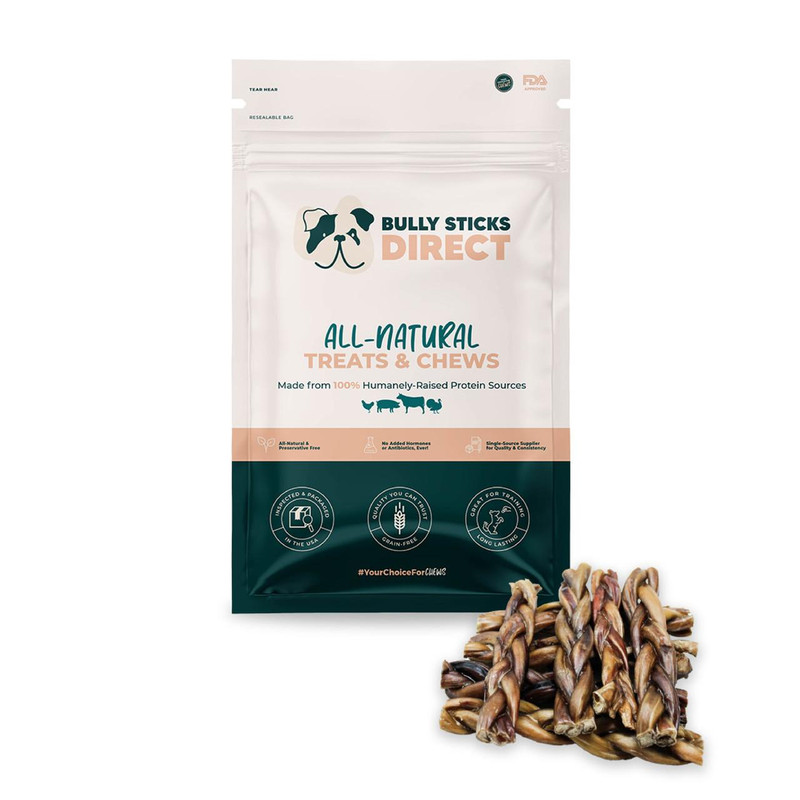


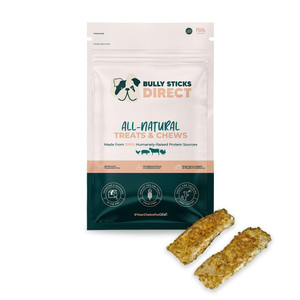
Description
The 6" Beef Cheek Strip Bully Stick Dusted is a different product category than a bully stick — understanding the difference is essential to knowing why it exists and who it is for. A bully stick is made from beef pizzle: the dried bull penis muscle, a smooth, single-fiber muscle that dries into a dense, uniform cylinder. A beef cheek strip is made from the masseter, the jaw muscle of the cattle. The masseter is one of the most heavily used muscles in the bovine body, resulting in dense, crossed-fiber muscle tissue that dries into a flat, layered strip with complex fibrous resistance entirely different from the smooth elasticity of pizzle.
The bully stick dust coating bridges these two products: ground beef pizzle applied to the surface of the cheek strip before final drying, coating it with the familiar beef pizzle scent and flavor that dogs who love bully sticks respond to. The dog's nose says "bully stick" — the texture they encounter says "this is different from anything I've had before." This combination is the product's purpose. For dogs that engage immediately and consistently with bully sticks because of the scent signal, the Bully Stick Dusted Cheek Strip extends that engagement signal to a format with a completely different chewing experience — one that delivers varied fibrous resistance, works jaw muscles differently, and provides genuinely novel textural stimulation in a 6-inch format appropriate for dogs of all sizes.
This is a variety-and-rotation product. It is not a longer-duration substitute for a bully stick, nor is it a denser chew for power chewers. It is the format for dogs whose owners want to give them something genuinely different once or twice a week without losing the appetitive engagement that bully stick scent triggers. Dogs that have received the same bully stick format daily for months often show reduced session times due to habituation. The Cheek Strip Dusted breaks the pattern with a texture so different that it cannot be habituated in the same way. At the same time, the scent coating ensures immediate, confident initial engagement.
Beef cheek vs. beef pizzle — why the chewing experience is completely different: Beef pizzle (bully stick) is smooth muscle — single-direction fiber bundles that dry into a uniform elastic cylinder. Resistance is consistent throughout; the dog applies compression, and the stick gives slightly, then rebounds. Beef cheek (masseter) is a skeletal muscle with crossed-fiber architecture — the fibers run in multiple directions, and the meat is denser and more fibrous. As the dog chews through a cheek strip, it encounters layered fibrous resistance that requires different jaw mechanics: more lateral and shearing forces rather than pure compression. The chew also behaves differently as saliva softens the surface — the outer layers begin to separate. At the same time, the interior remains firm, creating a texture progression during the session that a uniform bully stick doesn't produce. These are not better or worse — they are different, and variety in chewing texture is enriching in itself.
The Dental Health Case for Beef Cheek as a Rotation Chew
Bully sticks reduce oral bacteria by 60.2% in a session (2014 Rutgers University study). Beef cheek strips provide mechanical dental cleaning through a different mechanism — the layered fibrous structure separates during chewing, and the fibers create a flossing action between teeth that the smooth cylinder of a bully stick cannot replicate. Studies on canine dental health consistently find that variety in chew texture produces more comprehensive dental coverage than exclusive use of any single format, because different textures contact different areas of the dentition. A dog given bully sticks 3 times a week and beef cheek strips once a week covers more of its dental surface area through mechanical cleaning than a dog given bully sticks 4 times a week.
This is the dental case for using the Cheek Strip Bully Stick Dusted as a rotation piece: not instead of bully sticks, but alongside them, to extend mechanical cleaning to tooth surfaces and interdental spaces that bully sticks' uniform cylinder doesn't reach as effectively. The pizzle dust coating ensures that dogs that are accustomed to bully stick scent engage immediately and completely, rather than investigating the cheek strip with reduced interest.
Chew Time by Dog Weight
| Dog Weight | Chewer Type | Est. Session | Notes |
|---|---|---|---|
| 10–25 lbs | Moderate | 25–40 min | Well-sized variety rotation treat |
| 25–50 lbs | Moderate | 18–30 min | Good rotation piece for this range |
| 50–80 lbs | Moderate | 10–20 min | Use as enrichment; 12" version for more |
| Any | Heavy | Under 10 min | High-value training reward in pieces |
Nutrition & Sourcing Specs
Nutrition Per Strip
| Protein | High — beef muscle |
| Calories per strip | ~80–110 |
| Ingredients | Beef Cheek + Beef Pizzle Dust |
| Grain-free | Yes |
| Rawhide | None — beef muscle only |
| Digestibility | Fully digestible |
Sourcing & Processing
| Beef source | Grass-fed, free-range |
| Hormones/antibiotics | None |
| Coating | Ground beef pizzle dust |
| Chemical additives | None |
| Beef allergy safe | No — contains beef |
Frequently Asked Questions
Yes. The "bully stick dusted" coating is ground beef pizzle — the same material as a bully stick — applied as a powder coating to the surface of the beef cheek strip. The underlying chew is beef cheek muscle (masseter). The coating adds the familiar beef pizzle aroma and flavor that dogs conditioned to bully sticks respond to with immediate, strong engagement. It is not a flavoring or artificial scent — it is actual ground pizzle dust. The product is therefore made from two natural beef-derived ingredients: beef cheek and beef pizzle dust.
Session length varies widely by dog and chewing style. For moderate chewers (20–40 lbs), the 6" cheek strip typically provides 20–35 minutes — broadly comparable to a 6" Select bully stick, but with variability because the flat, layered texture is consumed differently by different dogs. Some dogs work through cheek strips slightly faster than an equivalent bully stick (the flat shape can be easier to grip and rip), and some take longer (the fibrous layers require different jaw mechanics). The cheek strip's value is not in identical or superior session length — it is in the different chewing experience, different jaw mechanics, different dental contact pattern, and the novelty that variety rotation delivers.
No. This product contains two beef-derived ingredients: beef cheek muscle and beef pizzle dust. Dogs with confirmed beef protein allergy or sensitivity should not receive this product. For beef-sensitive dogs wanting a shaped chew, see the 6-7" Pork Bully Stick Springs as the non-beef alternative in the BSD Shapes range.
1-in-4 to 1-in-5 sessions is a practical rotation frequency that provides meaningful variety without replacing the straight bully stick as the primary format. This gives your dog a different chew texture once per 1–2 weeks, maintaining the novelty-engagement benefit while keeping the familiar straight stick as the session baseline. For dental coverage reasons, every 5th chew session, a layered fibrous texture, like the cheek strip, covers tooth surfaces that the uniform pizzle cylinder contacts less thoroughly.
Instructions
Feeding Instructions :
Please monitor your dog while feeding these gourmet natural treats, they are fully digestible however, please always provide a fresh supply of drinking water for your pup.
Recommendations:
Store your bully sticks in the original zip lock bag under cool conditions