

Description
The Cow Ear Bully Stick Dusted answers the question that every senior dog owner eventually asks their veterinarian: "My dog loves bully sticks, but I'm worried the hard ones are hurting his teeth. What do I give him instead?" The answer is here. Cow ear is made primarily of auricular cartilage — the elastic tissue that gives the ear its flexible structure. Unlike dense pizzle muscle or beef cheek muscle, cartilage flexes under jaw pressure rather than resisting it. The dog applies compression; the ear compresses and rebounds rather than requiring the dog to push through dense resistance. This dramatically reduces the peak jaw force required per bite — making the cow ear appropriate for dogs whose dental wear, jaw sensitivity, or temporomandibular joint health rules out hard, dense chews.
The bully stick dust coating solves the problem that plain cow ears sometimes create for dogs conditioned to bully stick scent. Dogs that have received bully sticks consistently for years often approach unfamiliar chew formats with reduced enthusiasm — the novel scent registers as "this is not what I was expecting." The pizzle dust coating provides the familiar beef pizzle aroma that produces immediate confident engagement, while the soft ear format delivers the appropriate low-impact chewing experience. The dog's engagement is not reluctant novelty-testing — it is the same immediate motivated response that bully sticks always trigger, directed toward a format that is actually appropriate for their current dental and jaw status.
Cow ear cartilage also delivers genuine nutritional benefits beyond the protein provided by the pizzle dust. Cartilage is naturally rich in chondroitin sulfate and type II collagen — the compounds that support joint cartilage integrity and have been shown in multiple studies to support joint mobility in aging dogs. These are not added as supplements; they are naturally present in cartilage. For senior dogs simultaneously managing joint stiffness, dental sensitivity, and the behavioral need to chew, the Cow Ear Bully Stick Dusted is one of the few formats that addresses all three concerns in a single chew.
The thumbnail test — and how cow ear passes it for dogs that bully sticks shouldn't: Veterinary dentists use a practical guideline for chew hardness: if you press your thumbnail firmly into the chew and it leaves an impression, the chew is safe for most dogs. If it leaves no impression at all, it may be too hard for dogs with dental wear or sensitivity. Cow ear cartilage passes the thumbnail test — it compresses under thumbnail pressure and holds the impression. A standard bully stick, particularly in Select or higher weight tiers, leaves no thumbnail impression at all. For senior dogs where the question is "is this too hard?", the cow ear is definitely on the safe side of that threshold. The pizzle dust coating means the dog engages with it immediately and completely rather than showing the reduced interest that sometimes accompanies introducing a genuinely unfamiliar format to a bully-stick-habituated dog.
The Joint Health Case for Cow Ear Cartilage
Cow ear cartilage is naturally rich in type II collagen and chondroitin sulfate — the same compounds sold in expensive joint supplements marketed to owners of senior dogs. Type II collagen is the structural protein of joint cartilage; chondroitin sulfate is a glycosaminoglycan that helps cartilage retain water and resist compression. Both are present naturally in cow ear auricular cartilage, not as additives.
Research on chondroitin supplementation in aging dogs consistently finds improvements in joint mobility and reductions in lameness scores. A 2007 study in JAVMA found significant improvements in mobility measures in dogs supplemented with glucosamine and chondroitin versus placebo over 70 days. The dosing from a single cow ear is not equivalent to therapeutic supplementation — but for a senior dog given cow ears 2–3 times per week as part of a natural diet and enrichment routine, the cartilage consumption contributes meaningful chondroitin at low caloric cost, supporting joint health through whole-food nutrition rather than isolated supplementation.
For senior dogs simultaneously managing joint stiffness and dental sensitivity — a common combination in large breeds from age 8+ — the cow ear is one of the only natural chew formats that provides joint-supportive nutrition in a texture appropriate for compromised dental status. The combination is not coincidental: it is why cow ear is specifically recommended for senior dogs by veterinary-nutrition-aware owners, while power chewers are directed to denser formats.
Transitioning Senior Dogs from Hard Bully Sticks — A Guide for Owners
The transition from standard bully sticks to lower-impact chews is one of the most common senior dog care decisions owners face, and one of the least well-supported by available information. Here is the practical guide that veterinarians give owners who ask:
Signs that a senior dog should transition to softer chews: Pawing at the mouth during or after sessions. Reduced enthusiasm for familiar chews they previously loved. Reluctance to engage with their left or right side. Dropping food or chews more than usual. Slow eating. Any of these signs warrants a veterinary dental exam before giving any chew. If the vet clears the dog for continued chewing with softer formats, the cow ear is the appropriate starting point.
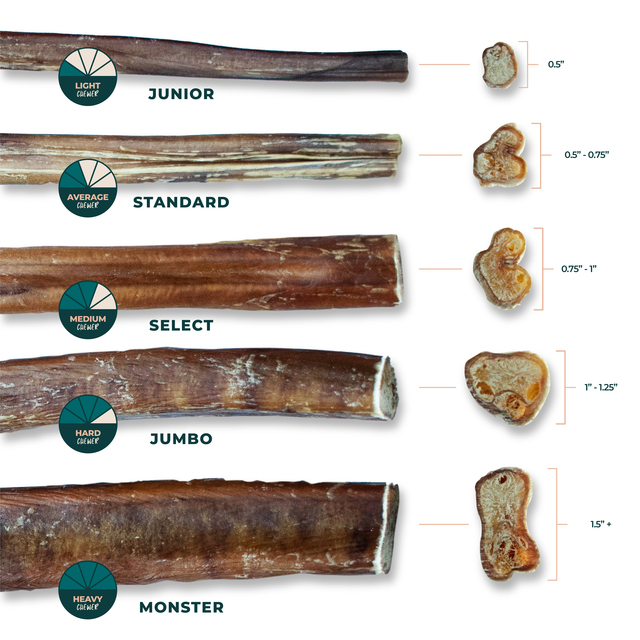
What "softer" means in practice: The veterinary dentist's guideline is the thumbnail test — if you cannot leave an indent with your thumbnail under firm pressure, the chew is too hard for dogs with dental wear or sensitivity. Cow ear cartilage passes this test. All straight bully stick tiers (Standard through Monster) do not — they are appropriate for dogs with healthy intact dentition and normal jaw function. This is not a subjective assessment: the materials' mechanical hardness is measurably different.
Introducing the cow ear dusted: Most dogs conditioned to bully sticks engage immediately with the Cow Ear Bully Stick Dusted because the pizzle dust coating provides the familiar scent signal they respond to. No introduction protocol is typically needed. Give the first session in a comfortable, familiar location, supervise, and allow the dog to pace themselves. Senior dogs often chew more slowly than they did at younger ages — this is appropriate and expected, not a problem.
Chew Time by Dog Size and Age
| Dog Size / Age | Chewer Type | Est. Session | Notes |
|---|---|---|---|
| Any size · Senior (7+ years) | Light–Moderate | 20–50 min | Ideal format — pass thumbnail test ✓ |
| Small · Adult (10–30 lbs) | Light | 25–55 min | Good everyday variety rotation chew |
| Medium · Adult (30–60 lbs) | Moderate | 18–35 min | Rotation/variety; straight stick for sessions |
| Puppy under 6 months | Light | 10–20 min supervised | Soft format; limit session length |
| Any | Heavy/Power | Under 10 min | Use as a training treat; a straight stick for sessions |
Nutrition & Sourcing Specs
Nutrition Per Ear
| Primary protein | Beef cartilage + collagen |
| Calories per ear | ~100–140 |
| Chondroitin | Naturally present in cartilage |
| Ingredients | Cow Ear + Beef Pizzle Dust |
| Fat content | Low — lower than pig ear |
| Digestibility | Fully digestible |
Sourcing & Processing
| Beef source | Grass-fed, free-range |
| Hormones/antibiotics | None |
| Processing | Oven-baked, natural process |
| Chemical additives | None |
| Compared to rawhide | Softer, fully digestible |
| Compared to a pig ear | Lower fat, less contamination risk |
Frequently Asked Questions
Cow ears are one of the safest chew options for senior dogs with dental wear, tooth sensitivity, or jaw sensitivity because their cartilage structure flexes under pressure rather than requiring hard biting. They pass the veterinary thumbnail test — press your thumbnail firmly into the ear, and it leaves an impression, confirming appropriate softness. Hard bully sticks (Standard tier and above) do not leave a thumbnail impression and are not appropriate for dogs with significant dental wear. If your veterinarian has advised avoiding hard chews, confirm with them whether cow ear cartilage is appropriate for your dog's specific dental and jaw status. Always supervise senior dog chew sessions and remove when the ear becomes thin enough to fold completely.
Yes — cow ear cartilage is naturally rich in chondroitin sulfate and type II collagen, both of which support joint cartilage integrity. These are not supplements added to the product; they are naturally present in bovine auricular cartilage. Dosing from a single cow ear is not equivalent to therapeutic joint supplementation. Still, for senior dogs given cow ears 2–3 times per week, the regular cartilage consumption provides chondroitin at a low caloric cost, alongside the behavioral and dental benefits of chewing. For senior large breeds managing arthritis alongside dental sensitivity, the cow ear is one of the few natural chew formats that addresses both simultaneously.
The underlying chew is identical — dried bovine auricular cartilage and skin. The difference is the ground beef pizzle dust coating applied to the surface. For dogs conditioned to the bully stick scent, this coating provides the familiar appetitive signal that elicits immediate, confident engagement. Plain cow ears have a different scent profile that some bully-stick-habituated dogs investigate with reduced enthusiasm on first introduction. The dusted version eliminates this problem: the dog smells the bully stick, engages immediately, and encounters the soft cartilage texture rather than requiring an introduction period with an unfamiliar-smelling format. For longtime bully stick owners transitioning a senior dog to softer chews, the Bully Stick Dusted version consistently produces better first-session acceptance than plain cow ear.
Both are soft cartilage-based chews appropriate for light chewers and senior dogs. Cow ears are lower in fat than pig ears — pig ear fat content is typically 25–35%, while cow ear fat content is considerably lower, making cow ears more appropriate for weight-conscious or pancreatitis-risk dogs. Cow ears are also less associated with reports of bacterial contamination than pig ears, which have been implicated in several Salmonella-related FDA recalls. The cartilage texture of both is similarly soft and flexible. For calorie-management and contamination-risk reasons, cow ear is the preferred recommendation when owners ask about soft ear chews for senior dogs.
Yes, with appropriate supervision and size management. The soft cartilage texture is safe for developing puppy teeth — it does not require the hard biting force that could stress or damage teeth that are not yet fully set. For puppies under 6 months, limit sessions to 10–15 minutes with close supervision. Ensure the puppy is not attempting to swallow large pieces — remove when the ear is consumed to a size that could be swallowed whole. For puppies beginning to chew, the cow ear's soft texture and the familiar bully stick scent of the dusted coating provide a positive first chewing experience that doesn't risk tooth damage or frustration with too-hard material.
Instructions
Feeding Instructions :
Please monitor your dog while feeding these gourmet natural treats, they are fully digestible however, please always provide a fresh supply of drinking water for your pup.
Recommendations:
Store your bully sticks in the original zip lock bag under cool conditions