
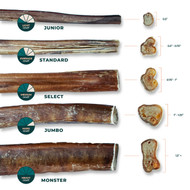
Bully Stick Thickness Guide — Thin, Standard, Thick, Jumbo, and Monster Explained
Posted by Greg C. on Jun 16, 2026
Most people shop for bully sticks by length — 6-inch, 12-inch, and so on. But there's a second dimension that matters more for how the chew actually performs, and it gets a fraction of the attention: thickness. A bully stick's thickness (its diameter) is the single biggest factor in how long it lasts and how well it withstands a determined chewer. Get the thickness right and you hand your dog a satisfying, long-lasting chew matched to their strength; get it wrong, and it's either gone in five minutes or so dense your dog can't make progress. The industry throws around terms like thin, standard, thick, jumbo, and monster without ever clearly explaining them — so this guide does. Below you'll find exactly what each thickness level means, why thickness beats length for durability, the honest trade-offs, and a tier-by-tier breakdown matched to your dog's chewing strength and to the right bully sticks to buy for each. By the end, you'll know precisely which thickness to reach for.
The quick guide: Bully stick thickness (diameter) drives durability more than length does. The ladder: Thin — small dogs, puppies, seniors, gentle chewers. Standard — the versatile default for most dogs. Thick — medium-to-large dogs and stronger chewers. Jumbo — large dogs and serious chewers. Monster — the largest breeds and the most powerful, determined chewers. Match thickness to your dog's chewing strength, not just body size. Honest trade-off: thicker lasts longer and resists strong jaws, but is harder on weak/young/old teeth and carries more calories per stick. When in doubt, Standard is the safe starting point — and you can size up or down from there.
Why Thickness Beats Length for Durability
Here's the insight that should change how you shop: for how long a chew lasts and how well it holds up, thickness matters more than length. Length sets the total amount of chew (and roughly the total calories), but a long, thin stick gets demolished fast by a strong chewer because there's little material in any cross-section to slow them down. A thick stick forces the dog to work — more density and diameter to grind through at every point — and that's what actually extends chew time and resists a powerful jaw.
Two sticks of the same 6-inch length can deliver completely different experiences: the thin one might last a strong chewer ten minutes, the thick one far longer. So when durability and chew time are the goal — especially for a serious chewer — thickness is the lever to pull. Length adds quantity; thickness adds staying power. Most shoppers fixate on length out of habit, but matching a chew to a powerful chewer is really about thickness.
How BSD sizes by thickness — we sort by weight, not looks. Here's the thing most brands won't tell you: two 12-inch sticks can look identical in a product photo while weighing dramatically different amounts — and weight, not appearance, is what determines density, durability, and chew time. That's why BSD sorts every stick by actual weight into guaranteed tiers — Standard, Select, Jumbo, and Monster "Jurassic" (with Supreme and Mega Monster grades too) — and weighs each one before it ships. A Monster Jurassic is 2–3 times heavier than a Select of the same length. When you buy by weight tier, you get exactly the density you're paying for. As we like to put it: dogs don't eat adjectives — dogs eat bully sticks.
The Five Thickness Tiers — and What to Buy
Thickness terminology isn't perfectly standardized, but these are the tiers, what each means, and the right bully sticks for each. Use your dog's chewing strength to find your tier.
The slimmest sticks, easy to chew through — ideal for small dogs, puppies, senior dogs, and gentle or occasional chewers who don't need (or can't handle) a dense, hard chew. They don't last as long for a powerful jaw, but for a Chihuahua, a small-breed puppy, or an older dog with weaker teeth, thin is exactly right: manageable and gentle on the mouth. Shop our 4–5" Bully Sticks for the little guys and gentle gnawers.
The versatile middle ground and our most popular tier. Standard thickness works for the broad majority of average dogs and typical chewers — substantial enough for a satisfying session without being so dense an average dog struggles. (At BSD, Standard is the lightest weight tier and Select is the next step up — a bit heavier and longer-lasting for moderate chewers.) Unsure where to start? Standard is the safe default. Browse our 6" Bully Sticks — the right call for most dogs.
A step-up in diameter for medium-to-large dogs and strong chewers who want a longer-lasting chew than standard chews deliver. More material and more resistance mean meaningfully extended chew time for dogs who'd otherwise finish a standard stick quickly. See our 12" Jumbo Bully Sticks for dogs that need more to work on.
Notably thick sticks for large dogs and serious chewers — the dogs who tear through thinner options and need real substance to stay occupied. Built to last for powerful chewers, and generally too much for small dogs. Reach for our 12" Jumbo Bully Sticks when standard and thick disappear too fast.
The thickest tier — what BSD calls Monster "Jurassic" — the maximum-durability option for the largest breeds and the most powerful chewers who destroy everything else. Each is 2–3 times heavier than a Select-sorted stick of the same length. Typically far too thick and hard for small dogs, puppies, or gentle chewers; this is specifically a big-powerful-dog product. Bring out the 12" Monster Jurassic Bully Sticks for the dog that's met its match in nothing yet.
Thickness and length are often combined (a 6-inch-thick stick, a 12-inch jumbo), so you can choose both — length for total quantity, thickness for durability and a match in chewer strength.
Quick Comparison — Thickness at a Glance
| Tier | Best For | Chew Effort | Durability | Calories |
|---|---|---|---|---|
| Thin | Small dogs, puppies, seniors | Easy | Lower | Lowest |
| Standard | Most average dogs | Moderate | Medium | Medium |
| Thick | Medium–large, strong chewers | Higher | High | Higher |
| Jumbo | Large dogs, serious chewers | High | Very high | High |
| Monster | Largest breeds, power chewers | Hardest | Highest | Highest |
Match Thickness to Your Dog — Not Just Their Size
The key principle is to match thickness to your dog's chewing strength and style, using body size only as a starting point. Size gives a baseline — small → thin/standard, medium → standard/thick, large → thick/jumbo, largest → jumbo/monster — but chewing intensity is what really decides it.
Then adjust for style. A small but ferociously determined chewer may need a thicker stick than their size suggests, because a thin one vanishes in minutes and can be reduced to a swallowable piece faster. A large but gentle, methodical chewer might be happier (and safer for their teeth) with standard rather than monster. Watch how your dog actually chews: aggressive crushers and tearers benefit from more thickness; delicate gnawers don't need extreme thickness. And account for age and teeth — puppies and seniors usually do better with thinner, easier sticks that are gentler on developing or aging teeth, even if body size suggests going thicker. When genuinely unsure, start with standard and adjust based on how fast your dog goes through it.
The Honest Trade-Offs of Thickness
Thicker isn't automatically better — it's a set of trade-offs:
Thicker lasts longer but is harder to chew. The density that makes a thick stick last is what makes it hard work. Great for a strong chewer; frustrating or even a tooth-stress risk for a weak jaw, small mouth, puppy teeth, or aging dentition. The chew should be challenging, not impossible.
Thicker means more calories per stick. More material, more calories. Keep treats within about 10% of daily calories — a monster stick is a bigger caloric event than a thin one. (See our bully stick calorie guide.)
Safety cuts both ways. A thick stick is harder for a strong chewer to quickly reduce to a swallowable chunk — a safety plus. But any stick, any thickness, should be supervised and taken away once worn to a small final piece. Thickness slows the dog's progress toward that point; it doesn't remove the need to supervise.
Choose the thickness that matches your individual dog: enough for a satisfying, appropriately lasting, safe chew for their strength, without going so thick that it's hard on their teeth or an unnecessary calorie load. The right thickness is the matched one — not simply the biggest.
Frequently Asked Questions
For durability and how long a chew lasts, yes — thickness generally matters more than length. Length mainly sets the total amount of chew (and roughly the total calories), but thickness determines how well the stick resists a chewer at every point. A long but thin stick gets demolished quickly by a strong chewer because there's little material in any cross-section to slow them down, whereas a thick stick forces the dog to work through more density and diameter, which extends chew time and stands up to a powerful jaw. Two sticks of identical length can perform completely differently depending on thickness — a thin 6-inch stick might last a strong chewer only minutes, while a thick 6-inch stick lasts considerably longer. So if your main concern is durability and keeping a determined chewer occupied, prioritize thickness. Length still matters for total quantity and for matching overall size to your dog, so the ideal approach is to choose both intentionally: thickness to match chewing strength (the durability factor), length for the total amount of chew. Most shoppers default to length, but for matching a chew to a serious chewer, thickness is the more important — and more overlooked — lever.
Match thickness to your dog's chewing strength and style, using body size as a starting point. By size: small dogs do well with thin to standard; medium dogs with standard to thick; large dogs with thick to jumbo; the largest breeds with jumbo to monster. Then make the crucial adjustment for chewing style — a small but ferociously determined chewer may need a thicker stick than their size suggests (a thin one disappears too quickly and can be reduced to a swallowable piece), while a large but gentle chewer might be content and safer with standard rather than monster. Watch how your dog actually chews: aggressive crushers benefit from more thickness for durability and safety; delicate gnawers don't need extreme thickness. Account for age and dental condition too — puppies and seniors usually do better with thinner, easier sticks that are gentler on developing or aging teeth, even if their size suggests thicker ones, since very hard, thick chews carry a higher tooth-stress risk. If you're unsure, standard thickness is the safe default because it suits the widest range of dogs, and you can adjust up or down based on how quickly your dog goes through it. The goal is a chew that's challenging and satisfying but not impossible or hard on the teeth.
Generally, the thickest sticks — jumbo and monster — aren't the best choice for small dogs, with one nuance. Monster and jumbo are designed for large breeds and the most powerful chewers, and they're typically too thick and hard for a small dog to chew effectively; a too-thick stick is simply frustrating, and very hard dense chews carry more risk for small or fragile teeth. So for most small dogs, thin-to-standard is the better match: chewable, satisfying, and gentler on the mouth. The nuance is chewing style — a small dog that's an unusually ferocious chewer might handle (and benefit from) a thicker stick than their size suggests, because a too-thin stick can be reduced to a swallowable piece very quickly by a strong small chewer, which is its own safety concern; in that specific case, stepping up in thickness can actually be safer by slowing them down. But that's the exception — most small dogs do best with thinner sticks. Regardless of thickness, always supervise your small dog and remove the stick once it's worn to a small final piece that could be swallowed or become a choking hazard, since small dogs are at particular risk from pieces too big for them. So, for most small dogs, skip monster and jumbo; choose thin to standard, and size up only if your small dog is an exceptionally powerful chewer.
Yes — thicker bully sticks contain more calories than thinner ones of the same length, because thickness means more material (more beef per stick). A bully stick's calories come from its total mass, so increasing diameter increases the amount of chew and the calorie content. A thick, jumbo, or monster stick is therefore a larger caloric event than a thin stick of the same length, which is worth factoring into your dog's daily intake. The general guideline is that treats — including chews — should make up no more than about 10% of daily calories, so a thicker, higher-calorie stick takes up more of that budget. For a large active dog, the extra calories may be easily accommodated, but for a smaller or less active dog, or one watching their weight, the difference between a thin and a thick stick matters. One practical approach: choose the appropriate thickness for durability, but offer the stick over multiple sessions (taking it away and saving it between chews) rather than letting the dog finish it all at once, which spreads the calories out. The bottom line is that thickness affects both durability and calories — a thicker stick lasts longer and contains more calories — so pick a thickness that matches your dog's chewing strength while keeping the calorie load appropriate for their size, activity, and overall diet.