Waterfowl vs Landfowl — Why the Bird Family Tree Decides Whether Your Poultry-Allergic Dog Can Eat Goose
Posted by Greg C. on Jun 10, 2026
Here's something most dog owners — and a surprising number of treat companies — get wrong: they treat "poultry" as one thing. Chicken, turkey, duck, goose, all lumped into a single category, all assumed to be equally risky (or equally safe) for a dog with a poultry allergy. But birds are not interchangeable, and for an allergic dog the differences between them can be the difference between a treat that's tolerated and one that triggers a reaction. The key to understanding why lies in the bird family tree — specifically, the split between landfowl (chicken and turkey) and waterfowl (duck and goose). These are two distinct branches of birds, separated by millions of years of evolution, and that evolutionary distance directly shapes how likely a dog allergic to one bird is to react to another. This is the single most useful concept for navigating poultry allergies in dogs, and once you understand it, the otherwise-confusing question of "which birds can my allergic dog eat?" becomes much clearer. This guide explains the bird family tree, why taxonomy predicts allergic cross-reactivity, and what the landfowl-waterfowl split means for choosing proteins for your dog.
The core concept, upfront: Birds split into two main branches relevant to dog diets: landfowl (chicken, turkey — the family Phasianidae) and waterfowl (duck, goose — the family Anatidae). Allergic cross-reactivity — the chance a dog allergic to one protein reacts to another — tracks how closely related the two species are, because related species share more similar proteins. So a chicken-allergic dog is fairly likely to also react to turkey (close relative, same landfowl family — an estimated 30–50% cross-react) but much less likely to react to duck or goose (distant waterfowl — roughly 10–20%). This is why goose is a far better bet than turkey for a chicken-allergic dog. The honest limit: waterfowl is lower-risk, not zero-risk, because some proteins are conserved across all birds — so goose should be introduced carefully and monitored. And mammals (camel, goat, pork, beef) sit on a completely different branch with no avian relationship at all, so they carry no poultry cross-reactivity and are the surest choice for a poultry-allergic dog.
The Bird Family Tree — Landfowl and Waterfowl
All the birds in your dog's diet trace back through an evolutionary tree, and the branches that matter most divide into two groups:
Landfowl (order Galliformes, family Phasianidae). This group includes chicken and turkey, as well as pheasant, quail, and grouse. These are ground-dwelling birds, and chickens and turkeys, in particular, are close relatives within the same family. Because they're so closely related, their proteins are structurally similar.
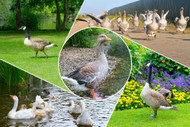
Waterfowl (order Anseriformes, family Anatidae). This group includes ducks, geese, and swans. These are water birds, and they sit on a distinctly different branch of the bird family tree from the landfowl — a different taxonomic order, representing a much deeper evolutionary divergence. Ducks and geese are close relatives (both in the family Anatidae), but they are distant relatives of chickens and turkeys.
The crucial point is the distance between the two groups. Chicken and turkey aren't just "both poultry" — they're close cousins. Goose and chicken are far more distantly related, separated by a much larger evolutionary gap. That gap is the whole reason the landfowl-waterfowl distinction matters for allergies, as the next section explains.
Why Taxonomy Predicts Allergic Cross-Reactivity
To understand why the family tree matters, you need to understand how allergic cross-reactivity works. A food allergy is an immune response to specific proteins — the immune system produces antibodies that recognize and react to a particular protein's structure. Cross-reactivity occurs when proteins from two different sources are sufficiently similar in structure that antibodies raised against one also recognize the other. The dog's immune system, in effect, "mistakes" the second protein for the first and mounts the same allergic response.
Here's the key link to the family tree: protein similarity tracks evolutionary relatedness. Closely related species inherited their proteins from a recent common ancestor, so those proteins remain very similar — and antibodies against one species' protein are likely to recognize the other's. Distantly related species have had far more evolutionary time for their proteins to diverge, so the proteins are less similar, and antibodies are less likely to cross-recognize them. This is a general principle across allergy science: the more closely related two species are, the higher the likelihood of cross-reactivity between them.
Apply that to birds, and the prediction is direct. Chicken and turkey (close relatives in the same family of landfowl) share similar proteins, so cross-reactivity between them is high. Chicken and goose (distant relatives, landfowl vs waterfowl) have more divergent proteins, so cross-reactivity is lower. The bird family tree, in other words, is a map of allergic risk — and the landfowl-waterfowl split is the most important boundary on that map.
The Cross-Reactivity Gradient — With Numbers
This isn't just theory; the pattern shows up in the estimated cross-reactivity rates. Think of it as a gradient running from "very likely to cross-react" to "no cross-reactivity at all":
| Protein | Group | Relationship to Chicken | Est. Cross-Reactivity |
|---|---|---|---|
| Turkey | Landfowl (Phasianidae) | Close relative (same family) | High (~30–50%) |
| Duck | Waterfowl (Anatidae) | Distant (different order) | Lower (~10–20%) |
| Goose | Waterfowl (Anatidae) | Distant (different order) | Lower (~10–20%) |
| Camel / Goat / Pork / Beef | Mammal | No avian relationship | None |
Read top to bottom, the gradient is clear. Turkey, the close landfowl relative, carries the highest cross-reactivity with chicken — which is why turkey is a poor choice for a chicken-allergic dog despite being "not chicken." Duck and goose, the distant waterfowl, cross-react far less, so the majority of chicken-allergic dogs tolerate them. And mammals, with no relationship to birds at all, carry no poultry cross-reactivity whatsoever. The practical takeaway is that for a chicken-allergic dog, "avoid poultry" is too blunt — the smarter rule is "avoid the close landfowl relatives (turkey), consider the distant waterfowl (goose, duck) as a much lower-risk option, and rely on mammals for the surest result."
The Honest Limit — Lower-Risk, Not Zero-Risk
It would be easy to oversimplify this into "waterfowl is safe for chicken-allergic dogs," but that overstates what the family tree guarantees, and getting this right matters for your dog. The accurate statement is that waterfowl is lower-risk, not zero-risk.
Here's why the risk isn't zero. While evolutionary distance reduces protein similarity overall, some proteins are highly conserved — they remain similar even across distantly related species because they perform essential functions that haven't changed much over evolutionary time. A few such proteins are shared across all birds, waterfowl included. This means a minority of chicken-allergic dogs — roughly the 10–20% reflected in the cross-reactivity estimates — can still react to goose or duck through these conserved shared proteins, even though most won't. The family tree shifts the odds substantially in your favor with waterfowl, but it doesn't eliminate the possibility.
The practical consequence: for a chicken-allergic dog, goose is a genuinely good, much-lower-risk option worth trying — but introduce it carefully, on its own, and watch for any reaction, rather than assuming it's guaranteed safe. If your dog has a history of severe allergies or you want the safest possible result with no risk of cross-reactivity, mammalian proteins are the safer choice. This honest framing — lower-risk and worth trying with care, not a guarantee — is the responsible way to use the landfowl-waterfowl insight.
The Mammalian Branch — A Different Tree Entirely
The landfowl-waterfowl distinction is about navigating within birds, but it's worth stepping back to see the bigger picture: mammals are on a completely different branch of the animal kingdom from all birds. Camel, goat, pork, and beef share no recent common ancestor with chicken, turkey, duck, or goose — the evolutionary distance is vast, and their proteins are correspondingly different. This is why mammalian proteins carry no poultry cross-reactivity at all: there's simply no structural similarity for a poultry-targeted antibody to recognize. For a poultry-allergic dog, this makes mammals the safest category — camel and goat especially, since they're also highly novel (rarely encountered in commercial food) and carry no cross-reactivity with beef. The bird family tree tells you the best avian options (waterfowl over landfowl); the broader animal tree tells you that stepping off the bird branch entirely, onto a mammal, is the safest move of all for a truly poultry-allergic dog.
What This Means for Choosing Your Dog's Proteins
Putting the family tree to work, here's the framework it gives you for a poultry-allergic dog:
Avoid the close landfowl relative. If your dog is allergic to chicken, turkey is the riskiest poultry choice because it's chicken's close cousin — skip it, even if it's "not chicken."
Consider waterfowl as a much-lower-risk option. Goose and duck, as distant waterfowl, are tolerated by most chicken-allergic dogs and are a reasonable choice to try with care — introduce carefully and monitor, knowing it's lower-risk rather than zero-risk.
Rely on mammals for the surest result. Camel, goat, pork, and beef carry no poultry cross-reactivity at all, making them the safest category — and camel and goat are also highly novel, ideal for difficult or multi-allergy cases.
This framework turns the confusing "Which birds can my dog eat?" question into a clear risk hierarchy. For the specific practical decisions — like whether your particular chicken-allergic dog can try goose, or how to choose between the mammalian options — see the related guides below, which apply this family-tree concept to real choices.
Frequently Asked Questions
Waterfowl and landfowl are two distinct branches of the bird family tree. Landfowl (order Galliformes, family Phasianidae) are ground-dwelling birds and include chicken and turkey, along with pheasant, quail, and grouse — chicken and turkey are close relatives within the same family. Waterfowl (order Anseriformes, family Anatidae) are water birds and include duck and goose, along with swans. The key point for dog owners is that these two groups sit on different branches, separated by a large evolutionary distance — they're in different taxonomic orders, representing a much deeper divergence than the gap between chicken and turkey (who are close cousins within landfowl). This matters for allergies because allergic cross-reactivity tracks how closely related two species are: closely related birds like chicken and turkey share similar proteins and cross-react more, while distantly related birds like chicken and goose have more divergent proteins and cross-react less. So a dog allergic to chicken (a landfowl) is fairly likely to also react to turkey (close landfowl relative) but much less likely to react to goose or duck (distant waterfowl). Understanding the landfowl-waterfowl split is the single most useful concept for choosing poultry proteins for an allergic dog.
It comes down to how closely related each bird is to chicken. Allergic cross-reactivity happens when proteins from two species are similar enough in structure that the immune system's antibodies recognize both — and protein similarity tracks evolutionary relatedness. Turkey is a close relative of chicken: both are landfowl in the same family (Phasianidae), so they share very similar proteins, and an estimated 30–50% of chicken-allergic dogs also react to turkey. Goose, by contrast, is waterfowl (family Anatidae), sitting on a distinctly different and more distant branch of the bird family tree — a different taxonomic order. Because goose and chicken are separated by much more evolutionary distance, their proteins are more divergent, and cross-reactivity is lower, roughly 10–20%, meaning most chicken-allergic dogs tolerate goose even when they can't have turkey. So the reason isn't that goose is "less of a bird" — it's that goose is a far more distant relative of chicken than turkey is, and that evolutionary distance translates into less protein similarity and therefore less cross-reactivity. This is exactly why the waterfowl-landfowl distinction is so useful: it predicts which birds an allergic dog is likely to tolerate.
No — goose is much lower-risk than turkey for a chicken-allergic dog, but it's not guaranteed safe, and it's important to be honest about that distinction. The waterfowl-landfowl distance means goose cross-reacts with chicken far less than turkey does (roughly 10–20% versus turkey's 30–50%), so the majority of chicken-allergic dogs tolerate goose. But the cross-reactivity isn't zero, because some proteins are highly conserved and remain similar even across distantly related birds, including waterfowl. This means a minority of chicken-allergic dogs can still react to goose through these shared conserved proteins. So the accurate way to think about goose for a chicken-allergic dog is "a genuinely good, much-lower-risk option worth trying with care" rather than "guaranteed safe." The practical approach is to introduce goose on its own and watch carefully for any reaction before relying on it. If your dog has a history of severe allergies or you want the surest possible result with no chance of cross-reactivity, mammalian proteins (camel, goat, pork) are the safer choice, since they have no relationship to birds and carry no poultry cross-reactivity. The waterfowl advantage is real and substantial — it just shifts the odds strongly in your favor rather than offering an absolute guarantee.
Yes — for a truly poultry-allergic dog, mammalian proteins are the surest choice, even safer than waterfowl. The reason is evolutionary distance taken to its logical conclusion. Within birds, waterfowl (goose, duck) are distant from landfowl (chicken, turkey), so they cross-react less — but they're still birds, and a few proteins are conserved across all birds, leaving a small residual cross-reactivity risk (around 10–20% for a chicken-allergic dog). Mammals — camel, goat, pork, beef — are on a completely different branch of the animal kingdom from all birds, separated by vast evolutionary distance, so their proteins share no meaningful structural similarity with poultry proteins. That means there's no cross-reactivity with mammalian proteins; a poultry-targeted antibody simply has nothing to recognize. So the hierarchy for a poultry-allergic dog is: turkey (riskiest, close landfowl), then goose or duck (much lower-risk distant waterfowl, worth trying with care), then mammals (surest, no poultry cross-reactivity). Camel and goat are especially strong mammalian choices because they're also highly novel proteins rarely found in commercial foods, and they carry no beef cross-reactivity, making them ideal for dogs with poultry allergies or multiple allergies. If you want the safest possible option with no chance of any poultry-related reaction, a mammalian protein is the way to go.