



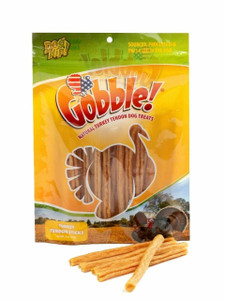
Description
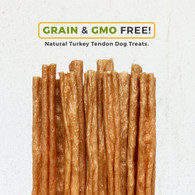
Gobble!'s Turkey Tendon Sticks are 22–25 thicker tubular pieces of 100% single-ingredient turkey tendon per 6 oz bag, dried naturally without additives, preservatives, or grain. Each stick produces 5–15 minutes of sustained jaw engagement depending on the dog's size and chewing intensity — the session-length range that delivers the full behavioral welfare benefit of long-session chewing: beta-endorphin release, cortisol suppression, the dental mechanical abrasion that accumulates across sustained fibrous jaw contact, and the focused calm behavioral state that 10+ minute chewing sessions produce regardless of protein source. At 70% crude protein and 5% crude fat, these are simultaneously the highest-protein and lowest-fat single-ingredient natural long-session chew in BSD's entire lineup — leaner than beef bully sticks (5–8%), leaner than collagen sticks (~10–15%), leaner than camel skin (8.96%), leaner than every other natural chew BSD carries. That 5% fat specification is not a secondary detail. It is the defining clinical characteristic that makes it appropriate for populations where every other natural chew fails the fat restriction requirement.
There are approximately 90 million dogs in US households, and roughly 9 million have food allergies — 10% of the population, per AVMA data. Of those, approximately 3 million are confirmed beef-allergic, representing the most common single-protein canine food allergy, accounting for 34% of cases per the BMC Veterinary Research systematic review. These 3 million beef-allergic dogs lose access to the entire beef-based long-session chew market overnight when the diagnosis is made: bully sticks, beef collagen sticks, beef gullet sticks, beef cheek rolls. Replacing these with a novel protein long-session chew that delivers comparable session length, comparable behavioral enrichment, and comparable palatability requires a product that is: single-ingredient, novel protein, appropriately sized for meaningful sessions, and lean enough to meet any concurrent fat management requirements. Turkey tendon sticks meet all four requirements from a single product. No other novel protein long-session chew in BSD's catalog combines these four properties simultaneously at a 5% fat specification.
The tissue source compounds the nutritional argument. Turkey tendon is not turkey meat. It is the connective tissue that connects the turkey muscle to the bone — composed primarily of densely packed type I collagen fibers running in parallel bundles along the tendon length, embedded in a proteoglycan-rich ground substance naturally containing glycosaminoglycans, including glucosamine. Every turkey tendon stick delivers three simultaneous nutritional contributions that muscle meat or hide chews cannot match: novel protein from turkey at 70% crude protein, natural type I collagen peptides from the tendon's primary structural protein, and naturally occurring glucosamine from the tendon's GAG matrix. The combination of novel protein allergen management, a lean fat profile, connective tissue collagen, and natural glucosamine in a single 5–15-minute chewing session per piece is genuinely unique in the natural single-ingredient chew market.
The beef-allergic large dog chew problem — and why turkey tendon sticks are the specific solution: A 70 lb Lab diagnosed with beef allergy loses the entire conventional long-session chew market in one diagnosis. Bully sticks: beef pizzle. Beef collagen sticks: beef corium. Beef gullet sticks: beef esophagus. Beef cheek rolls, beef tendons, beef ears: all Bovidae. The available novel protein hide alternatives — goat skin, camel skin — are appropriate and recommended for the beef-free rotation, but they are hide chews and serve a different format function. Turkey tendon sticks specifically replace the tubular stick format that bully sticks serve: the daily enrichment session where the dog settles in a familiar location, holds the stick with its front paws, and works progressively down the length over 8–15 minutes. That format — the stick — is what beef-allergic Labs, Goldens, and Shepherds have been receiving as their primary chew for behavioral enrichment for their entire lives. Turkey tendon sticks maintain that exact format-interaction pattern from a novel protein that is appropriate for the beef-free protocol, with a fat profile that is actually lower than the bully sticks being replaced.
The Turkey Tendon Nutrition Profile — What 70% Protein / 5% Fat Actually Means
The nutritional profile of turkey tendon reflects its tissue composition. Tendons are structural connective tissues with essentially no fat-storing function — their composition is primarily type I collagen fibers (approximately 65–80% of dry weight), proteoglycans (the glycosaminoglycan-rich matrix), water, and minor mineral content. There is no intramuscular fat to contribute a significant fat percentage, no subcutaneous fat layer as in hide-based chews, and no organ fat as in some novel protein organ treat formats. The 5% crude fat is the natural result of a fat-free tissue source.
The 70% crude protein comes from the collagen and proteoglycan proteins of the tendon — predominantly type I collagen, which provides the specific amino acids hydroxyproline, proline, glycine, and alanine in the ratios characteristic of connective tissue protein. This is not the same amino acid profile as muscle protein (actin and myosin from bully sticks or muscle-based treats), which is why turkey tendon and beef bully sticks are nutritionally complementary when rotated rather than nutritionally redundant substitutes. The bully stick provides muscle protein for energy and body composition; the turkey tendon stick provides connective tissue protein for structural support, from a novel protein source at substantially lower fat.
The naturally occurring glucosamine is derived from the proteoglycan ground substance embedded within the tendon structure. Glucosamine is a glycosaminoglycan — one of the key structural components of articular cartilage — and is naturally present in all connective tissues, including tendon, though at a lower concentration than in dedicated cartilage sources like trachea rings. For food-source glucosamine delivery through a novel protein treat, turkey tendon provides the relevant mechanism: each stick contributes naturally occurring glucosamine from the tendon's GAG matrix, accumulating over daily or near-daily treat sessions as a consistent food-source joint support contribution.
Turkey Tendon Sticks vs. Beef Bully Sticks — The Novel Protein Replacement Comparison
| Variable | Turkey Tendon Sticks | Beef Bully Sticks |
|---|---|---|
| Protein source | Turkey (Meleagrididae) | Beef (Bovidae — Bos taurus) |
| Tissue type | Connective tissue (tendon) | Muscle tissue (pizzle) |
| Crude protein | 70% | ~80–90% |
| Crude fat | 5% | 5–8% |
| Novel protein status | Less exposed for most dogs | Zero — #1 canine allergen (34% of cases) |
| Natural glucosamine | Yes — tendon GAG matrix | None — muscle tissue |
| Type I collagen | Yes — primary tendon protein | Minimal — muscle protein primary |
| Beef-allergic dogs | Appropriate (no poultry allergy) | Not appropriate |
| Format | Tubular stick — same grip pattern | Tubular stick |
| Session (50–60 lb dog) | 8–12 min per stick | Comparable at 6" length |
| Pancreatitis/hyperlipidemia | Appropriate at 5% fat | Borderline — confirm with vet |
For a beef-allergic dog transitioning off bully sticks: the tubular stick format, 5–15-minute per-piece session length, and the strong natural-scent palatability of turkey tendon sticks preserve the bully stick functional experience in every dimension except the protein. The dog's established chewing routine — location, grip, progressive engagement — transfers directly to turkey tendon sticks without retraining the chewing behavior. The novelty protein is the change; the behavioral experience is continuous.
The Novel Protein Exhaustion Problem — Why Turkey Tendon Is Still Genuinely Novel
The novel protein strategy erodes over time as formerly exotic proteins become commercially distributed at scale. Duck dominated pet food novelty in the mid-2010s — it now appears across hundreds of formulas from Blue Buffalo to Natural Balance to Hills. Venison follows the same trajectory. Bison, rabbit, and herring all appear in mainstream formulas. A dog that has eaten Taste of the Wild High Prairie (bison primary) for four years has lost venison and bison novelty entirely.
Turkey occupies a more nuanced position. It appears in some commercial pet food formulas, but at a dramatically lower prevalence than chicken, which dominates as the primary protein in the majority of mainstream kibble. The key distinction for novel protein management: it is not whether turkey appears in some commercial formulas — it is whether the specific dog has had repeated exposure to turkey protein at a frequency sufficient to build sensitization. For most standard-diet dogs, eating chicken-based kibble with chicken training treats and turkey tendon sticks provides genuinely reduced allergen exposure from a different protein. For dogs already managed on turkey-based limited ingredient diets for an extended period, turkey has lost its novelty for that individual dog. Always assess novelty individually for the specific patient.
The MLC-1 Cross-Reactivity — Understanding Exactly Who Turkey Serves and Who It Does Not
Myosin light chain 1 (MLC-1) is a muscle protein present in the skeletal muscle of all bird species. It is the primary cross-reactive allergen that links chicken, turkey, duck, goose, and all other poultry in the canine immune system. A dog that has developed IgE antibodies to chicken-specific MLC-1 also binds MLC-1 protein from turkey with comparable efficiency, because the MLC-1 protein sequence is highly conserved across all poultry species. This is why a confirmed chicken-allergic dog cannot receive turkey, goose, or duck products.
The clinical implication is precise: turkey tendon sticks are appropriate for dogs whose allergen list includes beef (Bovidae) but NOT chicken (Galliformes). The protein families are completely different — there is no cross-reactive allergen relationship between Bovidae beef proteins and Meleagrididae turkey proteins. Beef allergy does not predict turkey intolerance. For the clinical population of beef-allergic dogs without poultry allergy — the most common beef allergy presentation in veterinary dermatology, since beef and chicken allergy co-occur but are not causally linked — turkey tendon sticks are fully appropriate.
Breed-Specific Applications — The Five Breeds That Benefit Most
Labrador Retrievers (55–80 lbs, ~12% hip dysplasia rate per OFA) — Labs are BSD's most common large-dog customer, the most popular breed in America, and among the most food allergy-prone given their genetically elevated IgE antibody production. A beef-allergic Lab transitioning from daily bully sticks to turkey tendon sticks receives: the same tubular stick format in the same grip pattern, 8–12 minute sessions at the same enrichment depth, a protein that is genuinely less-exposed than the beef they can no longer have, at 5% fat — actually lower than most bully sticks — making it simultaneously appropriate for the Labs on concurrent weight management (POMC gene variant predisposing to obesity is common in the breed). The natural glucosamine from the tendon GAG matrix provides joint support relevant to a breed with a 12% prevalence of hip dysplasia. Turkey tendon sticks become the primary daily enrichment chew, replacing bully sticks entirely on the beef-free protocol.
Golden Retrievers (55–75 lbs, ~20% hip dysplasia rate per OFA) — Goldens have the same allergy predisposition as Labs, with even higher hip dysplasia rates. Beef-allergic Goldens in the 5+ year range, where joint support is a proactive priority benefit, specifically from turkey tendon sticks' combined novel protein + natural glucosamine + type I collagen profile. A senior Golden that has lost access to beef collagen sticks (beef corium) as her joint support chew due to a beef allergy gains a novel protein alternative that provides connective tissue collagen and natural glucosamine from the tendon structure — not an identical nutritional substitute for collagen sticks, but the closest available single-ingredient novel protein chew that contributes to the same joint support goals.
German Shepherds (55–90 lbs) — Shepherds with beef allergy benefit from the long-session format that turkey tendon sticks provide for the behavioral enrichment their high mental stimulation requirements demand. Shepherds with concurrent degenerative conditions (hip dysplasia, degenerative myelopathy) also benefit from the tendon collagen and glucosamine contributions. At 5% fat, turkey tendon sticks are appropriate for Shepherds on digestive-sensitive protocols where higher-fat chews cause GI disruption.
Miniature Schnauzers (13–20 lbs) — The breed most specifically served by the 5% fat specification alongside novel protein. Hyperlipidemia management (present in a disproportionate percentage of Miniature Schnauzers) requires fat restriction at the treat level. At Schnauzer size (13–20 lbs), each turkey tendon stick produces 12–18 minutes of engagement — a full enrichment session for a small breed. At 5% fat, it fits within most hyperlipidemia fat-restriction protocols at a single-stick serving level. For Schnauzers facing both hyperlipidemia and food sensitivity — a double constraint that eliminates virtually every conventional treat — turkey tendon sticks are the combination product that addresses both requirements simultaneously in a natural single-ingredient format.
West Highland White Terriers (15–22 lbs) — Westies are among the breeds most commonly presenting with food-responsive dermatitis in veterinary dermatology practice. Beef and chicken are the most commonly confirmed allergens in the breed. Westies with beef allergy and intact turkey tolerance benefit from turkey tendon sticks as their primary long-session enrichment chew — the natural poultry palatability profile is highly acceptable to most Westies, and the single-ingredient, no-additive profile eliminates secondary allergen concerns from undisclosed ingredients in commercial treat products.
Boxers (55–70 lbs) — Boxers have elevated food allergy rates alongside their cardiac predisposition (Boxer cardiomyopathy). Beef-allergic Boxers on cardiac-managed protocols benefit from the clean, single-ingredient transparency of turkey tendon sticks — no undisclosed additives, no sodium, no secondary proteins — and are appropriate for dogs on cardiac-sensitive dietary management, where full ingredient transparency at every treat is a medical requirement.
Per-Stick Session Time by Dog Size
| Dog Weight | Chewer Type | Est. Session per Stick | Recommended Serving |
|---|---|---|---|
| Under 15 lbs | Light–Moderate | 12–18 min | 1 stick — full enrichment session |
| 15–35 lbs | Moderate | 10–15 min | 1–2 sticks, depending on the session goal |
| 35–60 lbs | Moderate | 8–12 min | 1–2 sticks for a full enrichment session |
| 60–90 lbs | Moderate | 6–10 min | 2–3 sticks for a 15–25 min session |
| 90–100+ lbs | Moderate | 5–8 min | 3 sticks for an equivalent enrichment session |
| Any | Aggressive | 3–6 min | Use as a high-value rotation; supplement with strips |
How Turkey Tendon Sticks Fit in the Weekly Novel Protein Rotation
For dogs on novel-protein management or allergen-prevention rotation, turkey tendon sticks anchor the lean-poultry chew slot in a structured weekly protocol. The full three-product weekly rotation for a beef-allergic large dog covers behavioral enrichment, joint collagen delivery, and joint chondroitin delivery from non-beef protein sources:
| Day | Product | Function | Protein |
|---|---|---|---|
| Monday | Turkey Tendon Stick | Novel protein enrichment + natural glucosamine | Meleagrididae (turkey) |
| Tuesday | Goat Skin | Novel ruminant hide chew + long session | Bovidae Capra (goat) |
| Wednesday | Turkey Tendon Stick | Novel protein enrichment + natural glucosamine | Meleagrididae (turkey) |
| Thursday | Camel Skin | Most novel protein + maximum allergen distance | Camelidae (camel) |
| Friday | Turkey Tendon Stick | Novel protein enrichment + lean fat rotation | Meleagrididae (turkey) |
This five-session rotation provides daily long-session enrichment from three different protein families (none beef), three different tissue types (tendon, hide, hide from different species), and three different allergen-distance positions from the beef protein complex. Turkey tendon sticks anchor three of the five days as the primary novel protein enrichment chew — the lean fat anchor of the rotation at 5% crude fat across all three turkey days.
Frequently Asked Questions
Turkey tendon sticks are the most direct format replacement for a beef bully stick for a Golden without a confirmed poultry allergy. The tubular stick format is identical — she holds it with her front paws and works her way down the length over 8–12 minutes, the same interaction pattern she uses with bully sticks. The palatability is strong — the natural turkey scent is highly acceptable to most Goldens immediately. The 5% fat profile is comparable to and actually slightly leaner than most bully sticks. She receives novel protein from a protein her immune system has had substantially less exposure to, plus natural glucosamine from the tendon GAG matrix, contributing to the joint support her breed specifically needs from age 5 onward. First session: give one stick in a supervised context in the same location she normally receives bully sticks. Observe engagement — most Goldens accept turkey tendon sticks confidently in the first session. If she approaches it cautiously initially, warm the stick in your hand for a minute to enhance the scent signal. Monitor for any GI response over 24–48 hours before making this the daily enrichment chew. Discuss the complete beef-free treat protocol with your veterinarian — the food, the enrichment chews, and the training treats all need to be beef-free simultaneously for the elimination to be effective.
Turkey tendon contains naturally occurring glucosamine from its proteoglycan-rich ground substance — this is an established veterinary nutrition fact, not a claim requiring qualification. The honest framing of what that means and does not mean: turkey tendon is not a glucosamine supplement with a calibrated therapeutic dose standardized to treat diagnosed joint disease. A Cosequin DS capsule contains a specific milligram dose of glucosamine sulfate targeted to produce joint support at the veterinarian-prescribed frequency. Turkey tendon provides food-source glucosamine at the natural concentration present in tendon proteoglycan tissue — meaningful dietary glucosamine delivery that accumulates across regular treat sessions, not a therapeutic dose. For dogs already receiving glucosamine-chondroitin supplements for diagnosed joint disease, turkey tendon sticks complement the supplement protocol by adding food-source glucosamine through the treat channel, covering the joint-support function even on days when supplement compliance is lower. For dogs not yet on supplements in preventive management, turkey tendon sticks provide the most accessible natural-source glucosamine in a novel protein-chew format, appropriate for the preventive protocol before clinical symptoms appear. For dogs with severe diagnosed joint disease requiring maximum therapeutic dosing: continue the prescribed supplement and add turkey tendon sticks as a complementary food-source glucosamine contribution, not as a replacement for the veterinary protocol.
No — if your dog has a confirmed chicken allergy, turkey tendon sticks are not appropriate. Turkey shares the MLC-1 (myosin light chain 1) cross-reactive allergen with all poultry species, including chicken. A dog with confirmed chicken allergy has developed IgE antibodies to MLC-1 that bind to the conserved MLC-1 protein sequence in turkey muscle tissue — the immune system does not distinguish between chicken MLC-1 and turkey MLC-1 because the protein sequence is essentially identical across poultry species. For a dog with both beef allergy and chicken allergy, BSD's appropriate long-session novel protein chews are camel skin (Camelidae — no cross-reactive allergen relationship with either beef or chicken) and goat skin (Capra hircus — distinct from Bos taurus beef proteins with no established cross-reactivity, non-poultry with no MLC-1 relationship). Camel skin specifically addresses the most challenging multi-allergen scenario — it is from a biological family (Camelidae) with no established cross-reactivity with any of the five most common canine allergens, making it the correct product for dogs that have exhausted beef, chicken, and other common protein options.
Turkey tendon sticks with 5% crude fat are among the best available natural single-ingredient long-session chew options for a Miniature Schnauzer with hyperlipidemia. At 5% crude fat, they are the leanest single-ingredient natural chew in BSD's lineup — lower in fat than every alternative. The novel protein status of turkey (genuinely less-exposed than chicken or beef for most standard-diet Schnauzers) addresses the food-sensitivity component common in the breed, alongside hyperlipidemia management. The practical approach: confirm with your veterinarian the specific daily fat-gram limit for your Schnauzer's hyperlipidemia management based on her body weight. Then, calculate the fat contribution of one turkey tendon stick per session based on the estimated fat content. For a Schnauzer-sized serving, the fat contribution is low enough to fit within most moderate hyperlipidemia fat restriction protocols. Present this calculation to your veterinarian for clearance before making turkey tendon sticks a daily routine. Do not introduce any new treatment during an active hyperlipidemia management episode — only during stable managed periods with confirmed veterinary clearance.
Both are novel avian protein long-session chews appropriate for beef-allergic dogs without confirmed poultry allergy, and both are subject to the same MLC-1 poultry cross-reactivity limitation for confirmed chicken-allergic dogs. The functional differences between them are meaningful for choosing which serves your dog's specific needs better. Turkey tendon sticks are 100% tendon tissue — no bone, pure fibrous connective tissue at 70% protein / 5% fat with natural glucosamine from the tendon GAG matrix. Goose necks contain bone alongside the neck muscle and connective tissue — they provide natural glucosamine and chondroitin from the cartilaginous joint surfaces in the neck vertebrae, and the bone requires different supervision practices than boneless products (never give bone to dogs with jaw or dental limitations; always supervise completely; confirm with your veterinarian that raw or dried bone is appropriate for your dog's specific chewing behavior and dental status). Turkey tendon sticks are the boneless long-session novel poultry chew — safer for dogs where bone is contraindicated, appropriate for dogs with dental limitations, and providing the lean tendon collagen/glucosamine profile without the bone content. Goose necks provide a richer chondroitin and glucosamine profile from the neck cartilage, but require the supervision and confirmation of appropriateness that any bone product demands. Use both in rotation for maximum variety of novel avian proteins if both formats are appropriate for your dog.
Seal the bag completely immediately after every use — this is the single most important storage practice for naturally dried products without chemical preservatives. Moisture is the primary spoilage risk: naturally dried turkey tendon without preservatives will develop surface mold within days in a humid environment if left unsealed. Store in a cool, dry location away from direct sunlight and away from kitchen or bathroom humidity. For homes in humid climates (Southeast US, Pacific Northwest during wet season), transfer opened bags to an airtight sealed container for additional moisture protection. Opened bags: consume within 6–8 weeks for optimal freshness when stored sealed in a dry environment. Do not refrigerate — the temperature differential when removing from the refrigerator creates condensation on the product surface, which introduces moisture the product needs to stay away from. If purchasing multiple bags for bulk value, keep only one bag open at a time and store additional bags sealed in their original packaging until the active bag is consumed. Signs that the product has exceeded safe freshness: visible surface mold, an off smell distinctly different from the normal dried poultry scent, or visible moisture on the product surface. Discard and do not give to your dog if any of these signs are present.
Instructions
Feeding Instructions :
Please monitor your dog while feeding these gourmet natural treats, they are fully digestible however, please always provide a fresh supply of drinking water for your pup.
Recommendations:
Store your bully sticks in the original zip lock bag under cool conditions