



Description
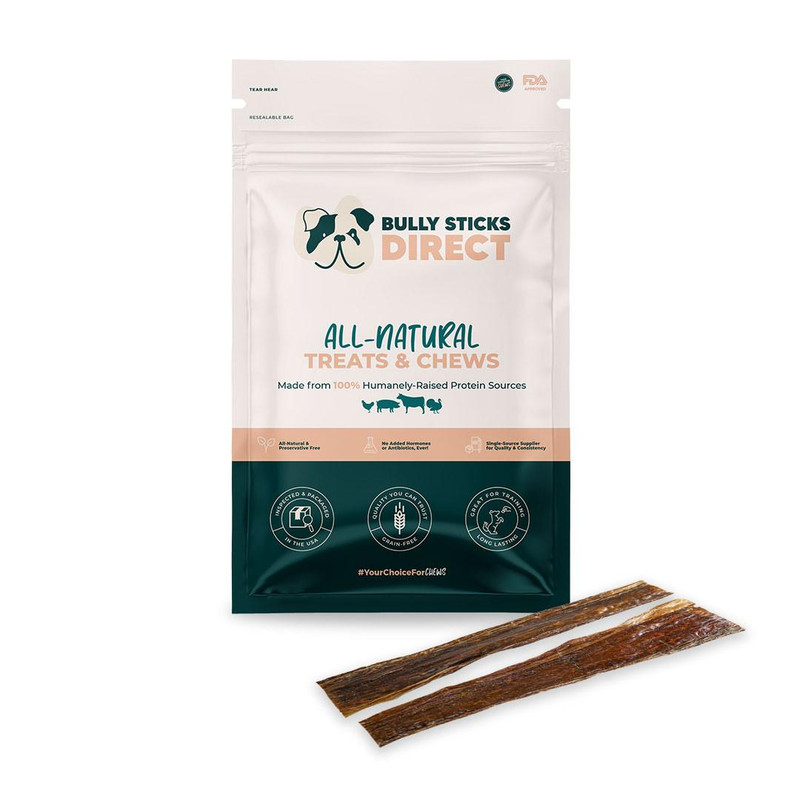
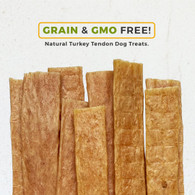
Gobble!'s Turkey Tendon Strips are 40–45 thin flat strips of 100% single-ingredient turkey tendon per 6 oz bag, dried naturally without additives, preservatives, artificial ingredients, or grain. Each strip produces 2–5 minutes of engagement per piece, depending on the dog's size and the per-reward consumption window, making these the training reward format of BSD's turkey tendon range. At 70% crude protein and 5% crude fat, they are simultaneously the highest-protein and lowest-fat single-ingredient natural training treat available in the BSD novel protein lineup. That fat number — 5% — is the defining clinical characteristic. It is lower than beef bully bites (5–8%), lower than any hide-based treat, and lower than every other single-ingredient natural chew BSD carries. For populations where the fat content of training treats is a medical management variable, turkey tendon strips are the only natural, single-ingredient option that fits.
There are approximately 9 million food-allergic dogs in the United States — 10% of the 90 million dogs in American households, according to AVMA 2025 data. The BMC Veterinary Research systematic review identifies chicken as the confirmed allergen in 15% of food-allergic dogs — roughly 1.35 million chicken-allergic dogs. Chicken is simultaneously the most common ingredient in training treats in the American pet market, appearing in virtually every commercial training biscuit, soft training treat, and chicken jerky reward product. The result: millions of dogs receiving their most common allergen at the highest frequency of any food delivery in their day, through training treats given 15–30 times per session, multiple sessions per week. Turkey tendon strips solve this for the specific population with beef allergy or chicken exposure concerns, but no confirmed poultry allergy: a single-ingredient, genuinely less-exposed novel protein training reward with the leanest fat profile available in natural form.
The tendon tissue itself adds a dimension that chicken or beef training treats don't provide. Tendon is connective tissue — type I collagen fibers in a proteoglycan-rich matrix naturally containing glucosamine. Even at the small per-strip serving size of a training reward, the tendon tissue provides a meaningful contribution of natural collagen peptides and glucosamine that accumulates over 20–30 rewards per training session. For dogs in active training programs where the owner wants every treat to contribute to the joint health protocol — particularly Labs, Goldens, and Shepherds in the 5+ year range where preventive joint support is the appropriate strategy — turkey tendon strips make every training session a simultaneous behavioral training event and a joint nutritional delivery event.
The training treats allergen problem — why switching to turkey strips matters for dogs receiving 25 chicken rewards per day: Veterinarians prescribing novel protein diets for food-allergic dogs focus correctly on replacing the primary food protein. What is consistently missed: the training treat protein. A 60 lb Lab on a novel protein venison food diet that is receiving 25 chicken training biscuits per training session, two sessions per day, is receiving 50 chicken protein exposures daily — at a much higher repetition frequency than any food ingredient. Food allergy sensitization is driven by repetitive exposure to the same protein. Training treats, given more frequently than any other single food item during the dog's day, are the primary exposure vehicle. Turkey tendon strips replace chicken training treats with a single-ingredient, novel-protein reward that is comparable in palatability, lower in fat, and higher in protein than chicken, from a protein the immune system has had substantially less exposure to. For dogs in active allergy management, this is not a minor upgrade — it closes the gap in the protocol that the food change alone left open.
Turkey Tendon Strips vs. Chicken Training Treats — The Complete Comparison
For owners replacing chicken training treats with a novel protein alternative, the direct comparison makes the case clearly:
| Variable | Turkey Tendon Strips | Typical Chicken Training Treats |
|---|---|---|
| Protein source | Turkey tendon (Meleagrididae) | Chicken (Galliformes) |
| Ingredients | Turkey tendon only | Chicken + multiple binders, flavors, preservatives |
| Crude protein | 70% | Typically 30–60% with added ingredients |
| Crude fat | 5% | Typically 8–20% |
| Grain-free | Yes | Often, no wheat, corn, or oats are common |
| Allergen status for beef-allergic dogs | Appropriate (no beef) | Appropriate (no beef) |
| Allergen exposure accumulation | Low — less commonly used protein | High #2 canine allergen at daily high frequency |
| Natural glucosamine | Yes — from tendon GAG matrix | None from muscle/grain matrix |
| For confirmed chicken-allergic dogs | No — MLC-1 cross-reactivity | No |
The Miniature Schnauzer Case — Why This Is Their Specific Product
Miniature Schnauzers face a combination of health constraints that eliminate almost every natural treat category at once. Hyperlipidemia management (present in a disproportionate percentage of the breed) requires fat-controlled treats — veterinarians typically prescribe less than 10% fat from treats, and many Schnauzer-specific protocols target under 5–8% fat from treat contribution. Food sensitivity (elevated in the breed) requires novel protein treats — standard beef and chicken treats are inappropriate. The combination of these two constraints eliminates beef bully sticks (5–8% fat — borderline, and beef), beef collagen sticks (10–15% fat — too high), camel skin (8.96% fat — borderline), goat skin (lean but variable), and virtually every commercial training treat on the market.
Turkey tendon strips at 5% crude fat and genuinely novel protein status for most Schnauzers on standard commercial diets address both constraints simultaneously. In the strip format, the smaller piece size further reduces the total fat contribution per training session compared to stick formats. For Schnauzer owners who have been struggling to find a natural single-ingredient training treat that fits their dog's dual management requirements: this is the product. Confirm the specific daily fat limit with your veterinarian, and calculate whether the per-strip fat contribution at your Schnauzer's body weight falls within that limit before establishing a daily frequency.
Breed Applications — Who Uses Turkey Tendon Strips
Labrador Retrievers in active obedience or hunting training programs that receive 20–40 rewards per session benefit from turkey tendon strips as a novel protein alternative to chicken training treats. Labs on beef-free protocols that have been continuing chicken training treats are receiving their #2 allergen at the highest frequency of any food delivery. Turkey closes this gap with a single product change to the training bag.
Golden Retrievers in training with food allergy management benefit similarly to Labs. Goldens in the 5+ year range also benefit from the tendon's natural glucosamine content, accumulating over 20–30 training rewards per session — food-source glucosamine delivered through the daily training reward channel that adds to whatever joint supplement protocol the Golden is on.
German Shepherds in working dog training programs need high-value rewards at high frequency. Turkey tendon strips provide a novel protein-high-value reward profile from a single-ingredient, no-additive product with full ingredient transparency — appropriate for working Shepherds on dietary management protocols, where undisclosed additives in commercial training treats create compliance complications.
French Bulldogs with food sensitivity in active training programs benefit from the novel protein low-fat strip format. At 5% fat and a piece size appropriate for Frenchie bite geometry, turkey tendon strips provide reliable training rewards from a less-exposed protein than the chicken-based commercial training treats that dominate the market.
West Highland White Terriers with beef allergy and intact turkey tolerance benefit from turkey tendon strips as high-frequency training rewards in the beef-free allergy management protocol. Westies are reactive dogs that require substantial positive reinforcement training for behavioral management — the training treat protein choice is particularly consequential for a breed receiving high training reward frequency.
Small breeds under 15 lbs — Yorkies, Chihuahuas, Maltese, Toy Poodles — benefit from the strip piece size as a full serving rather than as something requiring further portioning. At the strip format's per-piece size, small dogs receive appropriately sized novel protein rewards without needing to break pieces down further, making the strips the correct format for the small dog training and treat rotation.
Per-Strip Session Time and Training Use by Dog Size
| Dog Weight | Time per Strip | Training Session Yield | Best Training Use |
|---|---|---|---|
| Under 10 lbs | 4–6 min | 40–45 rewards per bag | Full strip per reward — appropriate size |
| 10–25 lbs | 3–5 min | 40–45 rewards per bag | Full strip; break in half for rapid-rep training |
| 25–55 lbs | 2–4 min | 40–45 rewards per bag | Full strip for jackpot; half strip for rapid-rep |
| 55–100 lbs | 2–3 min | 40–45 rewards per bag | Full strip as a jackpot reward; combine with sticks for sessions |
| Any size | Jackpot use | Reserve 3–5 strips per session | Full strip for breakthrough behavior reinforcement |
Using Turkey Tendon Strips During Elimination Diet Trials
The elimination diet trial — the gold standard for diagnosing food allergies — requires 8–12 weeks of exclusive novel-protein feeding, during which no exposure to the excluded protein occurs. Conventional training treats almost universally contain excluded proteins (chicken, beef, grain). Turkey tendon strips are single-ingredient turkey tendons with no secondary ingredients, no "natural flavors" that legally can conceal any protein source, and no added grain or preservatives. For elimination diet trials where turkey is on the approved protein list (beef-free, grain-free, dairy-free protocols where turkey is not being tested as an allergen), turkey tendon strips are among the most appropriate training treats available: single-ingredient, no-additive transparency, novel protein, appropriate for trial-period use. Confirm with your veterinarian that turkey is not on the excluded protein list for your dog's specific trial before the first strip.
Frequently Asked Questions
It is a significant management gap that is worth addressing. Food allergy sensitization develops through repetitive exposure to the same protein — the more frequently a protein is given, the faster sensitization builds in predisposed dogs. Chicken is the #2 most common canine food allergen, present in 15% of confirmed food allergy cases, according to the BMC Veterinary Research systematic review. A Lab receiving 25 chicken training rewards per session, two sessions per day, is receiving 50 chicken exposures daily — at a much higher repetition frequency than any single meal. Labs genetically produce elevated IgE antibody levels, giving them a lower sensitization threshold than most breeds. The combination of high-IgE genetics and daily high-frequency chicken exposure is precisely the pattern that drives chicken sensitization in Labs specifically. Switching to turkey tendon strips provides a less-exposed, novel-protein training reward with comparable palatability and lower fat. Turkey is appropriate for beef-allergic Labs without confirmed poultry allergy — the most common clinical scenario. If your Lab has already shown symptoms in the chicken (skin, GI, ear), confirm with your veterinarian whether poultry allergy has developed before switching to turkey, as MLC-1 cross-reactivity would make turkey also inappropriate if poultry allergy is confirmed.
Turkey tendon strips at 5% crude fat are among the best available natural single-ingredient options for a Schnauzer with hyperlipidemia. At 5% crude fat, they are lower in fat than virtually every natural single-ingredient treat available — lower than bully sticks, collagen sticks, hide chews, and most commercial training treats. The novel protein status is additionally appropriate for Schnauzers with food sensitivities (elevated in the breed). To confirm appropriateness, ask your veterinarian for the specific daily fat-gram limit for your Schnauzer's hyperlipidemia management based on your dog's body weight. Then estimate the fat contribution of one turkey tendon strip per reward at the training frequency you plan to use. Turkey tendon strips are low enough in fat that they typically fit within moderate hyperlipidemia fat restriction protocols. Still, the specific calculation for your Schnauzer's body weight and protocol limit is essential. Do not introduce during an active hyperlipidemia crisis — only during stable managed periods after veterinary clearance for the specific fat contribution level of turkey tendon strips.
Each strip contributes approximately 8–15 calories, depending on natural size variation within the production batch. For a 15 lb small dog on approximately 350 calories per day: 10 strips per day contributes roughly 100–150 calories, or 28–43% of daily intake — meaningful enough to warrant reducing kibble accordingly. For a 60 lb medium-large dog on approximately 1,000 calories per day: 15 strips per day contributes roughly 120–225 calories, or 12–22% of daily intake — also meaningful. The practical approach for any size dog: count the strip calories into the daily budget and reduce kibble by the equivalent amount on training-heavy days. The 5% fat profile means the calories come primarily from protein rather than fat — a favorable macronutrient profile for dogs where calorie source matters (weight management, body composition goals) compared to higher-fat treats where the same calorie count carries a higher fat contribution. At 40–45 pieces per 6 oz bag, the bag provides roughly 5–7 days of moderate daily use of training rewards before restocking is needed.
Yes — from 3–4 months onward, turkey tendon strips are appropriate for puppy training use. The soft-to-moderate texture of dried tendon is manageable for developing puppy teeth, and the strip piece size is appropriate for medium-breed puppies as a full reward and for large-breed puppies broken in half for rapid-repetition training sequences. Small-breed puppies under 5 lbs can receive the strips as full pieces from 3 months. The critical window for puppy training rewards: 3–6 months is the socialization critical period where positive reinforcement training produces the strongest learning outcomes, and high-value novel protein rewards drive more focused engagement than familiar commercial biscuits. Turkey tendon strips' strong natural scent is highly motivating for puppies encountering the protein for the first time. The 5% fat profile means daily training with turkey strips does not create a high-fat caloric burden alongside the puppy's high-protein growth diet. Introduce gradually — start with 5–8 strips in a first training session to assess response and GI tolerance before incorporating into the regular training treat rotation.
Yes — break 1–2 strips into small pieces and crumble them over the kibble surface immediately before presenting the meal. The dried turkey tendon has a strong natural poultry scent that enhances kibble palatability for most dogs, including picky eaters and dogs transitioning to less palatable prescription or therapeutic diets. The single-ingredient, no-additive profile — no artificial flavors, no salt, no palatability enhancers — means the scent enhancement comes entirely from the natural aroma of turkey tendon, appropriate for dogs on prescription diets where artificial flavor additives in commercial toppers could introduce undisclosed allergens or complicate the dietary protocol. For dogs on novel protein elimination diet trials where turkey is the approved protein, turkey tendon strip pieces crumbled over the novel protein kibble provide additional palatability support without introducing any protein outside the approved protocol. Confirm the specific use with your veterinarian during active elimination diet trials.
Yes — novel protein status is always individual and always temporal. If your dog has been eating turkey-based food or turkey treats regularly, turkey is no longer novel for that dog. The novelty that prevents allergic response requires a genuine first-exposure or minimal-exposure history with the protein. For a dog that has previously received a turkey-based limited-ingredient diet for 18 months and has developed symptoms, turkey has been sensitized and should be treated as an existing allergen, not a novel protein. For a dog that received turkey once at Thanksgiving two years ago and has had no subsequent turkey exposure, that single event is unlikely to have produced significant sensitization, and turkey remains functionally novel. The honest guidance: review your dog's complete dietary history before designating any protein as "novel" for their specific protocol. If you cannot definitively confirm the exposure history, the safest approach is to treat the protein as potentially non-novel and introduce it with a supervised trial session, while monitoring for response over 48–72 hours before incorporating it into the regular rotation.
Instructions
Feeding Instructions :
Please monitor your dog while feeding these gourmet natural treats, they are fully digestible however, please always provide a fresh supply of drinking water for your pup.
Recommendations:
Store your bully sticks in the original zip lock bag under cool conditions