Goose Necks for Dogs — The Complete Guide to the Novel Protein Chew That Replaces Both Bully Sticks and Joint Supplements
Posted by Greg C. on May 29, 2026
The goose neck is the single most underrated functional dog chew on the market — and for food-allergic dogs, it is arguably the most valuable individual product in the entire natural chew category. Most dog owners have never heard of it. Most pet stores don't carry it. And yet a goose neck delivers something that no bully stick, no collagen stick, and no commercial joint supplement delivers in a single product: a long-session enrichment chew, a novel avian protein safe for beef-allergic dogs, and a natural food source of glucosamine and chondroitin from genuine joint cartilage — all in one whole, single-ingredient chew. For the owner of a beef-allergic Labrador with early hip dysplasia, a Golden Retriever managing joint health alongside food sensitivity, or a senior dog that needs both behavioral enrichment and connective tissue support from a protein it has never been exposed to, the goose neck is not one of many options. It is the specific product that solves three problems simultaneously. This is the complete guide to what goose necks are, why the joint support is biologically real rather than marketing, and exactly which dogs benefit most.
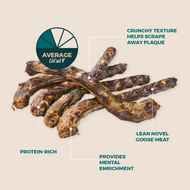
What a goose neck actually is, in one paragraph: A goose neck is the whole dried neck of a domestic goose (Anser anser domesticus, family Anatidae) — vertebrae, surrounding muscle, connective tissue, and the cartilage of the cervical joints, dried whole into a single-ingredient chew. The structure is the source of its unique value: the cervical vertebrae are connected by genuine joint cartilage rich in glucosamine and chondroitin sulfate, the same compounds sold in expensive joint supplements, delivered here in their natural food matrix. The surrounding muscle provides protein and the chewing engagement that produces long enrichment sessions. The bone provides dental abrasion and calcium. It is simultaneously a novel protein-enrichment chew (safe for beef-allergic dogs — goose is avian, with no bovine cross-reactivity) and a functional joint-support food. BSD's Goose Necks come in a 12-pack and are appropriate for dogs 25 lbs and up.
The Joint Support Science — Why It's Real, Not Marketing
The claim that goose necks support joint health is not a marketing flourish. It is a direct consequence of the anatomical structure of the neck and the biochemistry of the cartilage it contains. Understanding the mechanism makes it clear why goose necks occupy a category that ordinary muscle-meat chews cannot.
Glucosamine from joint cartilage: Glucosamine is an amino sugar that serves as a fundamental building block of glycosaminoglycans (GAGs) — the molecules that form the structural matrix of cartilage. In the body, glucosamine is synthesized from glucose and glutamine, but its rate of synthesis declines with age and may be insufficient to keep pace with cartilage breakdown in dogs with joint disease. Dietary glucosamine supplementation is the basis of the entire canine joint supplement industry. The goose neck delivers glucosamine in its natural form — from the actual cartilage of the cervical joints — rather than the synthetic or shellfish-derived glucosamine in commercial supplements. The cartilage between each cervical vertebra is genuine hyaline and fibrocartilage containing the glucosamine-rich GAG matrix.
Chondroitin sulfate from the cartilage matrix: Chondroitin sulfate is the most abundant GAG in cartilage and works synergistically with glucosamine. It attracts and holds water within the cartilage matrix, providing the compressive resistance that allows cartilage to cushion joints. Chondroitin also inhibits the degradative enzymes that break down cartilage in osteoarthritis. The cervical cartilage of the goose neck is a natural source of chondroitin sulfate in its food matrix — delivered alongside the glucosamine in the same ratio and structure that the body's own cartilage uses, rather than the isolated synthetic compounds combined in manufactured supplements.
The food matrix advantage: A meaningful body of nutritional science suggests that nutrients delivered in their natural food matrix — alongside the cofactors, proteins, and structural components they naturally occur with — may be utilized differently than the same nutrients isolated and delivered as supplements. The goose neck delivers glucosamine and chondroitin embedded in the complete cartilage matrix with the collagen, proteins, and trace minerals that naturally accompany them. This is not a claim that food-source delivery is definitively superior to supplements — the comparative bioavailability research in dogs is limited — but it is the logic behind feeding whole functional foods rather than relying solely on isolated supplements, and it is the reason many holistic and integrative veterinarians recommend goose necks and similar cartilage-rich chews as a food-source contribution to joint management.
Why Goose Necks Are Specifically Valuable for Food-Allergic Dogs
The joint support function is valuable for any dog. But goose necks become specifically irreplaceable for the food-allergic dog because of the convergence of two facts:
Fact 1 — Beef allergy eliminates the conventional joint chew. The conventional natural joint support chews are beef-based: beef gullet sticks (esophageal chondroitin), beef trachea (cartilage tube), and beef collagen sticks (type I collagen). For a beef-allergic dog, all of these are eliminated. The dog that needs joint support most — often a large breed with dysplasia risk — frequently also has the beef allergy that removes every conventional joint chew from the available options.
Fact 2 — Goose is a novel avian protein with no bovine cross-reactivity. Goose (Anatidae) shares no protein antigens with beef (Bos taurus). A beef-allergic dog can consume goose necks with no risk of beef-allergen cross-reaction. The goose neck restores the joint support function that the beef gullet and trachea provided, from a protein that the beef-allergic dog can safely eat.
This convergence is why goose necks are the #1 product recommendation for beef-allergic large breeds with joint considerations. The Labrador, Golden Retriever, and German Shepherd — the three breeds with the highest combination of food allergy prevalence and dysplasia risk — are the breeds for which the goose neck is the most specific answer. It is a rare product that addresses both the allergy constraint and the joint need simultaneously, without compromising either.
The MLC-1 caveat for chicken-allergic dogs: Goose is an avian protein that contains MLC-1 (myosin light chain 1), a conserved muscle protein that poses a cross-reactivity risk across all poultry species. For dogs with confirmed chicken allergy, goose carries a cross-reactivity risk and should not be introduced without veterinary confirmation of individual poultry tolerance. Goose necks are appropriate for beef-allergic dogs without a confirmed chicken allergy. For dogs with both beef and chicken allergy, camel skin and goat skin provide the hide chew slot, but neither delivers the glucosamine and chondroitin joint support that goose necks uniquely provide — a genuine gap in the protocol for dual beef-and-chicken-allergic dogs with joint needs that warrants veterinary discussion about supplement-based joint support as an alternative.
BSD's Goose Necks — The Product
BSD's Goose Necks are whole dried goose necks — single ingredient, no additives, naturally dried to preserve the cartilage matrix and the protein structure of the surrounding muscle. The whole-neck structure is what delivers the complete functional profile: the cervical vertebrae provide bone, and the dental abrasion benefit of working bone surfaces, the joint cartilage between vertebrae provides the natural glucosamine and chondroitin, and the surrounding muscle and connective tissue provide protein and the chewing engagement that produces sessions of 25–45 minutes for most medium-to-large dogs.
The goose used for BSD's products is sourced and produced in Poland — White Kołudzka geese from small family farms, processed under EU food safety standards. The geese are not raised in North America, and the product is not made in the USA — the goose is a genuinely novel protein precisely because it comes from a supply chain entirely separate from the North American commercial pet food system, which is what makes prior exposure essentially impossible for dogs raised on standard commercial diets.
The 12-pack provides approximately 4–6 weeks of rotation use at 2–3 sessions per week for a medium-large dog — the appropriate frequency for a functional joint-support chew used as part of a rotating novel protein protocol. As the centerpiece of the beef-allergic large breed's enrichment and joint support routine, goose necks anchor the protocol on the days when the long session plus joint support function is the priority.
Goose Necks vs the Conventional Joint Chews: They Replace
| Chew | Protein | Joint Nutrient | Beef-Allergy Safe? | Session Length |
|---|---|---|---|---|
| Goose Necks | Anatidae (novel) | Glucosamine + chondroitin (cartilage) | ✓ Yes | 25–45 min |
| Beef Gullet Sticks | Bovine | Chondroitin (esophageal) | ✗ No | 20–40 min |
| Beef Trachea | Bovine | Chondroitin (cartilage tube) | ✗ No | 10–20 min |
| Beef Collagen Sticks | Bovine | Type I collagen | ✗ No | 20–40 min |
| Commercial joint supplement | N/A (pill/chew) | Synthetic glucosamine/chondroitin | Varies — check ingredients | N/A — no enrichment |
The goose neck is the only entry in this table that is simultaneously beef-allergy safe AND delivers both glucosamine and chondroitin AND provides a long enrichment session. The beef-based chews deliver joint nutrients but fail the allergy constraint. The commercial supplement delivers nutrients but provides no enrichment value and none of the behavioral, dental, or cortisol-suppression benefits of an actual chewing session. The goose neck is the convergence product, which is precisely why it's so valuable for the specific dog that needs all three functions.
Breed-Specific Applications
Labrador Retrievers: The most common beef-allergic large breed and one of the highest dysplasia-risk breeds — OFA data shows approximately 12% hip dysplasia prevalence in Labs. The Lab that develops beef allergy (common) and has hip dysplasia risk (breed-typical) is the single most common profile for which goose necks are the ideal product. The novel avian protein addresses the allergy, the natural glucosamine and chondroitin support the joints, and the long session addresses the behavioral enrichment that food-motivated Labs specifically need. For Labs carrying the POMC gene variant (roughly 25% of the breed) with persistent food motivation, the extended goose-neck session provides sustained engagement that helps manage the breed's food-seeking behavior.
Golden Retrievers: Higher risk of dysplasia than Labs — OFA data show approximately 20% prevalence of hip dysplasia in Goldens, combined with elevated food allergy rates. Goldens also generally carry elevated rates of joint disease, making the food-source joint support of goose necks specifically relevant to the breed's lifetime joint management. For Goldens managing both food sensitivity and the breed's joint vulnerability, goose necks are a cornerstone product.
German Shepherds: Among the highest large-breed elbow dysplasia rates, plus approximately 20% hip dysplasia prevalence, combined with the breed's elevated food allergy and GI sensitivity. The single-ingredient clean format of goose necks is appropriate for the GI-sensitive Shepherd, and the joint support addresses the breed's significant orthopedic vulnerability. For the high-drive Shepherd, the long session also serves the critical behavioral enrichment need.
Rottweilers: The highest elbow dysplasia rate among common breeds — OFA data shows approximately 40% elbow dysplasia prevalence in Rottweilers. For a beef-allergic Rottweiler, the joint support function of goose necks is not a nice-to-have; it is directly relevant to managing the breed's extreme orthopedic risk profile. Rottweilers at adult weight need the larger goose necks and longer sessions appropriate to their size.
Senior dogs of any breed: Osteoarthritis affects approximately 20% of dogs over age 1 and 80% over age 8. For any senior dog — particularly beef-allergic seniors where conventional joint chews are eliminated — goose necks provide the food-source joint support alongside the gentle enrichment that aging dogs benefit from. The session length is appropriate for senior dogs at a slightly reduced frequency.
How to Use Goose Necks — Practical Protocol
Introduction: Standard novel protein introduction — supervised first session, 24–48 hour monitoring for any adverse response, three clean sessions before establishing regular rotation. For beef-allergic dogs without prior exposure to goose, adverse reactions are not expected.
Frequency: 2–3 sessions per week as part of a rotating novel protein protocol — alternating with camel skin, goat skin, and pork springs on other days to maintain protein variety and preserve each protein's novelty. The 2–3x-weekly frequency also provides a consistent joint nutrient contribution without daily repetition.
Supervision: Supervise all goose neck sessions. The whole-neck structure includes bone — confirm your specific dog chews progressively and safely. Most dogs work the neck progressively through the muscle and cartilage; monitor to ensure safe consumption. For brachycephalic breeds (French Bulldogs, Bulldogs) and small dogs, consult your veterinarian about whether the bone content of goose necks is appropriate for your specific dog before introducing.
Caloric management: A goose neck contributes approximately 90–150 calories, depending on size. On goose neck days, reduce kibble by the appropriate amount to maintain caloric balance — particularly important for the weight-prone large breeds (Labs, Goldens) that are the primary goose neck users.
Frequently Asked Questions
Goose necks provide a meaningful food-source contribution of glucosamine and chondroitin from genuine joint cartilage — but they should be understood as a functional food contribution to joint health rather than a replacement for a veterinarian-prescribed therapeutic dose of joint supplements in a dog with diagnosed osteoarthritis. For a dog with a significant diagnosis of joint disease, the veterinarian-prescribed glucosamine and chondroitin supplement at the therapeutic dose, plus potentially other interventions (omega-3 fatty acids, prescription joint diets, pain management), is the medical treatment. The goose neck is a complementary food-source contribution that delivers these nutrients in their natural matrix as part of a daily routine — valuable as preventive support, as a complement to medical treatment, and as the joint-relevant chew choice over a chew with no joint nutrient content. For a healthy dog with dysplasia risk but no current joint disease, the goose neck's food-source glucosamine and chondroitin is a reasonable preventive contribution. For a dog with diagnosed osteoarthritis, discuss with your veterinarian how goose necks fit alongside the prescribed joint management protocol rather than treating them as the sole joint intervention.
Goose necks are appropriate for beef-allergic dogs without a confirmed chicken allergy. Goose is Anatidae — an avian protein with no shared antigens or established cross-reactivity with Bos taurus bovine beef proteins. A beef-allergic dog can consume goose without risk of a beef-allergen cross-reaction. The one caveat is a chicken allergy: goose, like all poultry, contains MLC-1 (myosin light chain 1), a conserved avian muscle protein that poses a cross-reactivity risk across poultry species. If your dog has a confirmed chicken allergy in addition to or instead of a beef allergy, goose carries MLC-1 cross-reactivity risk and should not be introduced without veterinary confirmation of individual poultry tolerance. For beef-only allergy with intact chicken tolerance: goose necks are safe. Introduce with the standard protocol — a supervised first session and 24–48-hour monitoring — to confirm individual tolerance, as you would with any new protein.
The bones in a dried goose neck are raw-style poultry bones that have been dried rather than cooked at high temperature — they do not have the splintering risk associated with cooked bones, which become brittle and dangerous when heated. Dried poultry necks are widely fed as a raw, natural chew. However, appropriateness depends on your specific dog: most medium-to-large dogs can safely consume goose necks by working through them progressively, but supervision is required for every session to confirm safe consumption, and the bone content makes goose necks inappropriate for some dogs. Dogs that gulp rather than chew progressively, dogs with a history of bone-related GI issues, brachycephalic breeds with compromised swallowing anatomy, and very small dogs may not be appropriate candidates for goose necks specifically because of the bone content. Consult your veterinarian about whether goose necks are appropriate for your specific dog, particularly for small breeds, brachycephalic breeds, or any dog with a history of GI sensitivity or obstruction. For dogs where whole goose necks are not appropriate, BSD's other goose products (hearts, cubes, strips) provide the novel goose protein without the bone content.
BSD's four goose products serve different functions, all derived from the same novel protein. Goose necks are the whole-neck format — bone, cartilage, and muscle together — providing long-session enrichment plus the natural glucosamine and chondroitin from joint cartilage. They are the joint-support and primary-enrichment product. Goose hearts are dried cardiac muscle — soft, taurine-rich, and a high-value training reward that replaces beef liver treats. Goose cubes are pre-portioned muscle meat cubes for standard training rewards. Goose strips are lean muscle strips for medium-session enrichment and lighter chewing. The necks are the only goose product with the bone and cartilage structure that delivers joint support — the hearts, cubes, and strips are muscle-meat products without the cartilage joint nutrients. For a dog where joint support is the priority, goose necks are the specific product. For training rewards, the hearts and cubes are appropriate. For lean medium-session chewing without bone, the strips are appropriate. Many beef-allergic dog owners use goose necks as the primary enrichment and joint chew alongside goose hearts or cubes as training rewards — the full goose range covering multiple daily treat functions from one novel protein.
Goose necks are primarily recommended for dogs 25 lbs and up because of the overall neck size and bone content. For small dogs under 25 lbs, the appropriateness of a whole goose neck should be confirmed with your veterinarian — the bone content and the size of the neck relative to a small dog's anatomy create considerations that don't apply to larger dogs. For small dogs that would benefit from goose protein, BSD's other goose products may be more appropriate: goose strips for lean medium-session chewing without the bone content, goose cubes broken to small-dog-appropriate sizes for training and enrichment, and goose hearts for soft training rewards. These muscle-meat goose products provide the novel avian protein for small dogs without the whole-neck bone structure. If joint support is specifically the goal for a small dog, discuss food-source versus supplement-based glucosamine and chondroitin options with your veterinarian, since the goose-neck format that delivers food-source joint nutrients is sized for larger dogs.