Goose Cubes for Dogs — The Pre-Portioned Novel Protein Training Treat for Beef-Allergic Dogs in Daily Training
Posted by Greg C. on Jun 01, 2026
Most dog training happens in small repetitions, not grand moments. The sit that gets reinforced for the hundredth time. The loose-leash walking rewarded every few steps. The recall practiced in the backyard before it's ever tested at the park. This high-frequency, high-repetition reinforcement is the actual engine of dog training — and it requires a specific kind of treat: small, consistent, quickly consumed, and valuable enough to motivate but not so rich that thirty repetitions overload the dog's calorie budget or stomach. For beef-allergic dogs, the standard high-frequency training treats are off the table — commercial training treats are typically beef or chicken based, and the beef bits and training rolls that trainers reach for are exactly what the beef-allergic dog cannot have. Goose cubes are the answer to this specific need: pre-portioned, single-ingredient muscle meat from a novel avian protein, sized for the standard reward delivered many times per session, safe for beef-allergic dogs, and clean enough for dogs with the GI sensitivity that often accompanies food allergy. This is the complete guide to goose cubes — what they are, how they fit into a training program, and why they're the daily workhorse reward for the food-allergic dog.
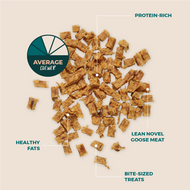
What goose cubes are, in one paragraph: Goose cubes are pre-portioned cubes of dried goose muscle meat (Anser anser domesticus, family Anatidae) — single ingredient, no additives, cut and dried into consistent bite-sized pieces ideal for training rewards. As skeletal muscle meat rather than organ meat, they are the standard reward tier — moderate-high value, appropriate for the high-frequency repetitions that make up the bulk of any training session. As a novel avian protein, they're safe for beef-allergic dogs (no bovine cross-reactivity), and the single-ingredient format is appropriate for dogs with GI sensitivity. BSD's Goose Cubes come in a 10.58 oz (300g) bag and work for dogs of all sizes, broken smaller for tiny dogs and high-frequency training.
Why the Standard Reward Tier Matters as Much as the Jackpot
Training advice often focuses on high-value rewards, but the standard reward — the treat delivered most frequently — is where the real work of training happens, and choosing it well matters more than most owners realize.
The volume of standard rewards: In a typical training session, the dog earns far more standard rewards than jackpots. A 15-minute session reinforcing several behaviors might yield 30–50 rewards, only a handful of which are jackpot-level. The standard reward is the one the dog earns dozens of times — which means its qualities (size, consumption speed, palatability, caloric load, allergen safety) shape the entire session more than the occasional jackpot does. A poor standard reward — too large, too slow to chew, too low in value, or containing a problem ingredient — degrades the whole training session.
The consumption-speed requirement: A standard training reward must be consumed quickly so the dog can re-engage and earn the next repetition without breaking the training rhythm. A treat the dog has to chew for thirty seconds kills the pace of a session. Goose cubes are sized and textured for quick consumption — the dog takes the cube, eats it in a moment, and is ready for the next repetition. This consumption speed is a specific functional requirement of a good standard reward, and it's why a pre-portioned cube format works better for high-frequency training than a chew that must be worked.
The caloric-load constraint: 30 to 50 rewards per session add up. If each reward is calorie-dense, a few training sessions a day can push a dog over its caloric budget and cause weight gain. The standard reward must be small enough that high-frequency delivery doesn't overload calories. Goose cubes can be used whole for larger dogs or broken into smaller pieces for small dogs and high-frequency sessions, keeping the per-reward caloric contribution managed even across many repetitions.
The Beef-Allergic Dog's Training Problem — Solved at the Standard Tier
The training reward challenge for beef-allergic dogs exists at both tiers, but it's arguably more acute at the standard tier due to sheer volume. A beef-allergic dog earning 40 rewards per session is at risk of 40 allergen exposures per session if the standard reward is a commercial treat with beef or undisclosed beef-derived "natural flavors." The high frequency of the standard reward makes it the largest cumulative allergen-exposure risk in the entire training routine.
Commercial training treats compound this risk in two ways. First, many are outright beef- or chicken-based. Second, even those marketed as different proteins frequently contain "natural flavors" that can be beef-derived, plus grain binders, glycerin, and preservatives — multiple potential allergen and GI-irritant exposures delivered dozens of times per session. For a beef-allergic dog, and especially one with concurrent GI sensitivity, the standard training treat is a hidden, high-frequency source of the exact exposures the allergy management protocol is trying to eliminate.
Goose cubes eliminate this risk completely. Single ingredient — goose muscle meat, nothing else. Novel avian protein with no bovine cross-reactivity. No grain binders, no glycerin, no preservatives, no "natural flavors." The beef-allergic dog can earn 40 goose-cube rewards in a session with zero allergen exposure and zero GI-irritant exposure. The standard reward tier — the highest-volume, highest-risk channel — is made completely allergen-safe.
BSD's Goose Cubes — The Product
BSD's Goose Cubes are pre-portioned cubes of dried goose muscle meat — single ingredient, no additives, cut to a consistent bite-size that works as a standard training reward straight from the bag for medium and large dogs, or broken into smaller pieces for small dogs and high-frequency sessions. The consistency of the pre-portioned format is a practical advantage for training: every reward is roughly the same size, making caloric tracking predictable and keeping the reward value consistent across a session. The texture supports quick consumption so the training rhythm stays unbroken.
The goose is sourced and produced in Poland from White Kołudzka geese raised on small family farms under EU food safety standards — a supply chain entirely separate from the North American commercial pet food system, which is what gives goose its genuine novel-protein status. The product is not made in the USA; that separation from the domestic commercial supply chain is precisely what makes prior exposure essentially impossible for dogs raised on standard commercial diets.
At 10.58 oz, the bag provides a substantial supply for daily training. As the standard tier in a two-treat system (goose cubes for routine repetitions, goose hearts for jackpots), the cubes are the higher-volume product — depleting faster than the hearts because they're delivered for the bulk of repetitions while hearts are reserved for the high-value moments. Many owners go through cubes faster than any other goose product precisely because they're the everyday workhorse.
Goose Cubes vs Goose Hearts — The Two-Tier System
| Variable | Goose Cubes | Goose Hearts |
|---|---|---|
| Tissue type | Skeletal muscle | Cardiac muscle (organ) |
| Reward tier | Standard — routine reps | Jackpot — high-value moments |
| Perceived value | Moderate-high | High (organ meat) |
| Frequency of use | High — most repetitions | Selective — breakthroughs only |
| Taurine content | Lower | Rich (cardiac) |
| Beef-allergy safe | ✓ Yes | ✓ Yes |
| Best role | Daily training workhorse | The reward that breaks through hard moments |
Using both together is the most effective training reward system for a beef-allergic dog. The cubes carry the volume — the routine reinforcement that builds and maintains behaviors. The hearts provide the value contrast that makes the jackpot function work for the genuinely difficult moments. Both from the same novel protein means the entire training reward architecture — standard and jackpot — is covered without any beef exposure. This is the complete beef-free equivalent of the muscle-meat-plus-organ-meat reward system that non-allergic dogs get from beef bits and beef liver.
Breed and Situation Applications
Puppies in early training: The foundational training window — roughly 8 weeks to 6 months — involves an enormous amount of repetition as the puppy learns basic behaviors, house manners, and socialization responses. This is the most frequent training period in a dog's life, and the standard reward is delivered constantly. For a puppy on a novel-protein protocol (or a puppy being proactively raised on rotated novel proteins to preserve future options), goose cubes, broken into puppy-appropriate small pieces, provide clean, allergen-safe rewards for foundational training volume. The small size and quick consumption keep young puppies engaged without overloading their small calorie budgets.
Labrador Retrievers: The most trainable and most food-motivated common breed, and frequently beef-allergic. Labs thrive on high-frequency reward training, and goose cubes are the clean standard reward for the breed's training volume. The caveat is the Lab's bottomless appetite — break the cubes into smaller pieces and track the caloric contribution carefully, since a food-motivated Lab will happily train all day and the calories add up.
German Shepherds and other working breeds: High-drive working dogs in obedience, protection sports, or service training require high-volume, high-precision training programs. Goose cubes serve the standard-reward volume these programs require, with goose hearts as the jackpot for the demanding behaviors — the full two-tier system from a novel protein for beef-allergic working dogs.
Dogs with GI sensitivity: For dogs with food allergy plus the GI sensitivity that often accompanies it (common in German Shepherds, and seen across breeds), the single-ingredient cleanliness of goose cubes matters at every one of the dozens of rewards per session. Commercial training treats deliver additives and binders at high frequency; goose cubes deliver only clean muscle protein. For the GI-sensitive dog, the standard reward being clean is as important as it being allergen-safe.
How to Use Goose Cubes — Practical Protocol
Introduction: Standard novel protein introduction — supervised first exposure, monitor 24–48 hours for any adverse response, confirm tolerance before regular use. For beef-allergic dogs without prior exposure to goose, adverse reactions are not expected.
Sizing: Use whole cubes as the standard reward for medium-large dogs. Break into smaller pieces for small dogs, puppies, and high-frequency sessions with many rewards. Smaller pieces extend the bag and keep per-reward calories low for high-volume training.
Pair with hearts: Run the two-tier system — cubes for routine repetitions, goose hearts reserved as the jackpot for breakthroughs, difficult behaviors, and high-distraction situations. This preserves the hearts' value and gives the cubes a clear role as the everyday workhorse.
Caloric management: Even small training treats add up across high-frequency sessions. Track the daily training treat volume and reduce meal portions on heavy training days. For weight-prone breeds, break cubes into small pieces and count them toward the daily caloric budget.
Frequently Asked Questions
Goose cubes are appropriate for beef-allergic dogs without confirmed chicken allergy. Goose is Anatidae — an avian protein with no shared antigens or established cross-reactivity with bovine beef proteins, so a beef-allergic dog can eat goose cubes with no risk of beef-allergen cross-reaction. The standard caveat for all goose products applies: goose contains MLC-1, the conserved avian muscle protein that creates cross-reactivity risk across poultry species, so for a dog with confirmed chicken allergy, goose carries cross-reactivity risk and should not be introduced without veterinary confirmation of individual poultry tolerance. For beef-only allergy with intact chicken tolerance, goose cubes are safe — introduce with the standard protocol of a supervised first exposure and a 24–48-hour monitoring window to confirm individual tolerance before using them at high frequency in training.
They're the two tiers of a complete training reward system. Goose cubes are skeletal muscle meat — the standard reward, moderate-high value, used for the high-frequency routine repetitions that make up most of a training session. Goose hearts are cardiac muscle — organ meat, with higher perceived value and rich in natural taurine — used as the jackpot reward reserved for breakthroughs, difficult behaviors, and high-distraction moments. The most effective approach uses both: cubes as the everyday workhorse delivered dozens of times per session, hearts as the high-value jackpot for the moments that most need maximum motivation. Reserving the hearts for jackpots preserves their value contrast, which is what makes the jackpot function work. If you want only one goose training product, choose cubes for general high-volume training, or hearts if you specifically need maximum-value rewards for difficult behaviors. Both are beef-allergy safe, so the choice is about reward tier rather than allergen safety.
Yes — goose cubes work well as a single training treat for most training, particularly routine and foundational work. They're a clean, allergen-safe standard reward that covers most training needs. The limitation of using only cubes is that you lose the value contrast of a two-tier system: for genuinely difficult behaviors, high-distraction recalls, or counter-conditioning a reactive dog, a higher-value jackpot reward (like goose hearts) produces better results because the dog perceives it as distinctly more valuable. If your training is mostly routine — basic obedience, manners, foundational behaviors — goose cubes alone are sufficient. If you're working on difficult behaviors, behavior modification, or competitive/working performance, adding goose hearts as the jackpot tier meaningfully improves results. For a beef-allergic dog where simplicity is the priority, goose cubes alone are a solid choice that covers most training needs; for maximum training effectiveness with hard behaviors, the two-tier cubes-plus-hearts system is better.
Break the cubes into smaller pieces sized for a small dog's mouth and calorie budget. A single goose cube broken into 3–5 small pieces provides multiple training rewards while keeping each reward appropriately small for a 10-pound dog's tight caloric budget (roughly 250–300 calories daily for a dog that size). Small dogs benefit especially from breaking down cubes because high-frequency training can otherwise quickly overload their small calorie budget. The quick-consumption texture of goose cubes is an advantage for small-dog training — the small pieces are eaten in a moment, keeping the training rhythm flowing. Reduce the dog's meal portion on training days to account for treats, and monitor weight monthly, as small dogs can gain or lose weight quickly relative to their size. Broken pieces should be stored sealed and used within a reasonable window to maintain freshness.
For beef-allergic dogs, and especially those with concurrent GI sensitivity, goose cubes have clear advantages over most commercial training treats. Commercial training treats are frequently beef- or chicken-based, and even those marketed as different proteins often contain "natural flavors" that may be beef-derived, as well as grain binders, glycerin, and preservatives. Delivered dozens of times per training session, these represent a high-frequency source of exactly the allergen and GI-irritant exposures an allergy management protocol is trying to eliminate. Goose cubes are single-ingredient — goose muscle meat, nothing else — from a novel avian protein with no bovine cross-reactivity, with no additives of any kind. For the beef-allergic dog, this means the highest-frequency reward channel becomes completely allergen-safe and GI-clean. The trade-off is that goose cubes are a single-ingredient natural product rather than a soft, shelf-stable commercial treat, so they require slightly more attention to storage and may have a different texture than the soft commercial treats some dogs are used to. For allergy management, that trade-off strongly favors the clean single-ingredient option.