Goose Hearts for Dogs — The Taurine-Rich Novel Protein Training Treat That Replaces Beef Liver for Food-Allergic Dogs
Posted by Greg C. on Jun 01, 2026
Every serious dog trainer knows a specific truth that most pet owners never discover: not all training treats are equal, and organ meat outperforms everything else. For decades, the highest-value training reward in a professional trainer's bag was beef liver — the concentrated organ meat whose intense palatability produces the focused, motivated, eager-to-work state that makes a dog learn faster and respond more reliably than the same dog working for ordinary biscuit treats. The problem for the growing population of beef-allergic dogs is that beef liver is off the table entirely. The dog that needs the highest-value reward to overcome a difficult training challenge — the reactive dog learning to stay calm, the anxious dog building confidence, the working dog mastering a complex behavior — is often the same dog whose beef allergy eliminates the organ meat reward that would work best. Goose hearts solve this precisely. They deliver the organ-meat palatability and the dense nutritional profile that drives training motivation, from a novel avian protein that beef-allergic dogs can safely eat. This is the complete guide to goose hearts: cardiac muscle nutrition, taurine content and why it matters, training applications, and the specific dogs for which goose hearts are the answer.
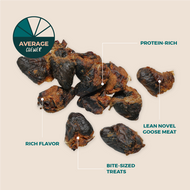
What goose hearts are, in one paragraph: Goose hearts are the dried cardiac muscle of the domestic goose (Anser anser domesticus, family Anatidae) — whole hearts, single ingredient, naturally dried, no additives. Cardiac muscle is a distinct tissue type from the skeletal muscle of ordinary meat treats: it is denser, richer in the specific nutrients that working muscle requires, and notably high in taurine — an amino acid concentrated in cardiac tissue that plays important roles in canine heart health. As a novel avian protein, goose hearts are safe for beef-allergic dogs (no bovine cross-reactivity) and deliver the organ-meat palatability that makes them the high-value training reward replacement for beef liver. BSD's Goose Hearts come in an 8.81 oz (250g) bag and are appropriate as training rewards for dogs of all sizes.
Why Organ Meat Drives Training Motivation
The reason professional trainers reach for organ meat rather than biscuit treats for high-stakes training comes down to the palatability intensity that organ tissue produces — and the behavioral state that intensity creates in the dog.
Concentrated nutrient density signals high reward value: Organ meats — heart, liver, kidney — are the most nutrient-dense tissues in any animal. They concentrate vitamins, minerals, and the rich flavor compounds that the canine palatability system is evolutionarily tuned to seek. A dog's reward system responds to the nutrient-density signal of organ meat with a stronger motivational response than it produces for lower-density muscle meat or grain-based treats. The dog experiences organ meat as a higher-value reward — and reward value is the single most important variable in operant conditioning. A higher-value reward produces faster learning, more reliable behavior, and the ability to compete with environmental distractions that lower-value rewards cannot overcome.
The jackpot principle: Effective training uses reward tiers — standard rewards for routine repetitions and high-value "jackpot" rewards for breakthroughs, difficult behaviors, and high-distraction situations. The jackpot reward must be distinctly more valuable than the standard reward to function. Goose hearts serve as the jackpot tier — the organ-meat reward that the dog perceives as significantly more valuable than the standard muscle-meat training treat. Reserving goose hearts for the moments that most need maximum motivation — the recall away from a squirrel, the calm response to a trigger, the completion of a complex behavior chain — preserves their value and gives the trainer a genuinely high-value tool for the hardest training moments.
The food-allergic dog's training disadvantage — solved: Beef-allergic dogs in training programs have historically been at a disadvantage because the organ-meat rewards that drive the best training results were beef-based. Trainers managing beef-allergic dogs had to work with lower-value reward options, resulting in slower progress on difficult behaviors. Goose hearts eliminate this disadvantage — the beef-allergic dog now has access to an organ-meat jackpot reward from a novel protein, putting it on equal footing with non-allergic dogs in the quality of reward available for training.
The Taurine Story — Why Cardiac Muscle Matters Nutritionally
Beyond their training applications, goose hearts have a specific nutritional relevance that distinguishes them from ordinary muscle-meat treats: their taurine content.
What taurine does: Taurine is an amino acid that plays critical roles in canine physiology — particularly in cardiac function, where it supports the heart muscle's contractile capacity and electrical stability. It is also important for vision, bile acid conjugation, and neurological function. While dogs can synthesize taurine from other amino acids (unlike cats, which require dietary taurine), certain dogs and certain conditions can make dietary taurine more important.
Cardiac muscle is taurine-rich: Taurine is concentrated in metabolically active tissues — and cardiac muscle, which never rests, is among the most taurine-dense tissues in the body. Goose hearts, as dried cardiac muscle, deliver taurine in its natural food form, alongside the complete profile of nutrients that working cardiac tissue contains. This makes goose hearts a functionally distinct treat from skeletal-muscle products — they contribute taurine that ordinary muscle meat provides in lower concentration.
The DCM context: Dilated cardiomyopathy (DCM) is a serious heart condition in dogs, and taurine deficiency has been identified as a contributing factor in some cases — particularly in certain breeds and, more recently, in association with some grain-free diets that came under FDA investigation. Golden Retrievers, in particular, have been identified as a breed in which taurine status and DCM risk warrant attention. While goose hearts are not a treatment for DCM and should never replace veterinary cardiac care, their natural taurine content makes them a functionally relevant treat choice for owners who want their treat selection to contribute taurine in a natural food form — particularly for breeds with taurine-related cardiac considerations. Any dog with diagnosed or suspected cardiac disease should be managed by a veterinarian, and dietary taurine support should be discussed with that veterinarian rather than self-managed through treats alone.
BSD's Goose Hearts — The Product
BSD's Goose Hearts are whole dried goose hearts — single ingredient, no additives, naturally dried to preserve the cardiac muscle's nutrient profile and the organ-meat palatability that makes them effective training rewards. The whole-heart format can be used as-is for medium and large dogs as a single high-value reward, or broken into smaller pieces for small dogs and for high-frequency training where multiple rewards per session are needed. The soft, dense texture is easy for dogs to consume quickly during training — important for maintaining the rhythm of a training session, where a reward that takes too long to chew breaks the flow.
The goose is sourced and produced in Poland from White Kołudzka geese raised on small family farms under EU food safety standards — a supply chain entirely separate from the North American commercial pet food system, which is what makes goose a genuinely novel protein with essentially no prior exposure for dogs raised on standard commercial diets. The product is not made in the USA; its novel protein status precisely stems from its separation from the domestic commercial supply chain.
At 8.81 oz, the bag provides a substantial supply of training rewards — broken into appropriate sizes, it covers many weeks of regular training sessions for most dogs. As the jackpot tier in a two-treat training system (goose cubes as the standard reward, goose hearts as the jackpot), one bag of hearts lasts considerably longer than the cubes because the hearts are reserved for the high-value moments rather than every repetition.
Goose Hearts vs the Training Rewards They Replace
| Training Reward | Protein | Reward Value | Beef-Allergy Safe? | Taurine |
|---|---|---|---|---|
| Goose Hearts | Anatidae (novel) | High — organ meat | ✓ Yes | Rich (cardiac) |
| Beef Liver | Bovine | High — organ meat | ✗ No | Moderate |
| Beef training bites | Bovine | Moderate — muscle | ✗ No | Lower |
| Commercial training treats | Varies + additives | Variable | Check ingredients | Variable |
| Goose Cubes | Anatidae (novel) | Moderate-high — muscle | ✓ Yes | Lower than hearts |
Goose hearts are the only entry that combines high organ-meat reward value, beef-allergy safety, and a rich natural source of taurine. Beef liver matches the reward value but fails the allergy constraint. Commercial training treats carry additive and undisclosed-protein risks that undermine an allergy management protocol. Goose cubes (the companion product) are the beef-allergy-safe standard reward, with goose hearts as the higher-value jackpot above them.
The Two-Tier Training System With Goose
The most effective way to use BSD's goose training products is a two-tier reward system that gives the trainer both a standard reward and a jackpot from the same novel protein:
Standard tier — Goose Cubes: Pre-portioned muscle-meat cubes for routine repetitions — the maintenance behaviors, the precision work, the high-frequency rewards of a normal training session. Goose cubes are the workhorse reward delivered many times per session.
Jackpot tier — Goose Hearts: The organ-meat reward reserved for the moments that most need maximum motivation — breakthroughs on difficult behaviors, recalls away from strong distractions, calm responses in counter-conditioning, completion of complex behavior chains. The dog perceives the hearts as distinctly more valuable than the cubes, which is exactly what makes the jackpot function work.
This two-tier system from a single novel protein is specifically valuable for beef-allergic dogs because it provides the full training reward structure — standard and jackpot — that non-allergic dogs get from beef muscle and beef liver, but entirely within the beef-free protocol. The dog gets the complete training reward architecture without any beef exposure.
Breed-Specific Applications
Golden Retrievers — the taurine connection: They have been specifically identified in discussions of taurine status and DCM risk in dogs. For Golden owners managing a beef-allergic Golden, goose hearts serve a dual purpose: a high-value training reward the breed responds to (Goldens are highly food-motivated and train beautifully with good rewards) and a natural source of taurine relevant to the breed's cardiac considerations. This is not a substitute for veterinary cardiac monitoring or prescribed taurine supplementation where indicated — but for the routine treat choice, a taurine-rich organ meat is a functionally sensible selection for the breed.
German Shepherds and working breeds: Shepherds and other high-drive working breeds in protection sport, obedience competition, search and rescue, or service training depend on reward quality for performance. Goose hearts provide the organ-meat jackpot reward these programs require for the most demanding behaviors, from a novel protein that beef-allergic working dogs can use without compromising their training program.
Labrador Retrievers: The most food-motivated common breed and frequently beef-allergic. Labs respond to organ-meat rewards with intense motivation, and the goose heart jackpot is specifically effective for the breed. The caveat for Labs is caloric management — the food-motivated Lab will happily consume unlimited hearts, so portion control and breaking hearts into smaller pieces for the jackpot moments help keep the caloric contribution in check.
Reactive and anxious dogs (any breed): Behavior modification — counter-conditioning a reactive dog, building confidence in an anxious dog — depends on high-value rewards to create the positive emotional association that changes the dog's response to triggers. Goose hearts provide the high-value reward that counter-conditioning protocols require, from a novel protein for the reactive or anxious dog that also has food sensitivity.
How to Use Goose Hearts — Practical Protocol
Introduction: Standard novel protein introduction — supervised first session, monitor for any adverse response over 24–48 hours, confirm tolerance before regular use. For beef-allergic dogs without prior exposure to goose, adverse reactions are not expected.
Portioning: Break whole hearts into appropriate sizes for the dog and the training context. For small dogs and high-frequency training, smaller pieces allow more rewards from the same amount and help keep the caloric contribution in check. For medium-large dogs receiving hearts as occasional jackpots, a whole or half heart per jackpot moment is appropriate.
Reserve for jackpots: To preserve their value, use goose hearts as the jackpot tier rather than the every-repetition reward. Goose cubes or another standard reward for routine repetitions; hearts for the high-value moments. Hearts used for every repetition lose their distinct value as a jackpot.
Caloric management: Organ meat is nutrient-dense and calorie-dense. Track the caloric contribution of training treats, especially for weight-prone breeds and during high-frequency training periods. Reduce meal portions on heavy training days to maintain caloric balance.
Frequently Asked Questions
Goose hearts are appropriate for beef-allergic dogs without confirmed chicken allergy. Goose is Anatidae — an avian protein with no shared antigens or established cross-reactivity with bovine beef proteins. A beef-allergic dog can consume goose hearts with no risk of beef-allergen cross-reaction. The caveat, as with all goose products, is chicken allergy: goose contains MLC-1, the conserved avian muscle protein that creates cross-reactivity risk across poultry species. For a dog with a confirmed chicken allergy, goose poses an MLC-1 cross-reactivity risk and should not be introduced without veterinary confirmation of individual poultry tolerance. For a beef-only allergy with intact chicken tolerance, goose hearts are safe — introduce them using the standard protocol of a supervised first session and a 24–48 hour monitoring window to confirm individual tolerance.
Goose hearts are a natural food source of taurine, and taurine plays important roles in canine cardiac function — but goose hearts should be understood as a nutritionally relevant treat choice rather than a cardiac treatment. For a healthy dog, the taurine in goose hearts is a sensible nutritional contribution as part of a varied diet, particularly for breeds like Golden Retrievers where taurine status has been a topic of attention. For a dog with diagnosed cardiac disease such as dilated cardiomyopathy (DCM), or suspected taurine deficiency, the treatment is veterinary cardiac care including diagnostic testing and, where indicated, prescribed taurine supplementation at therapeutic doses — not treats. Goose hearts cannot reliably deliver a therapeutic dose of taurine and should never replace veterinary cardiac management. If you have cardiac concerns about your dog, or your dog is on a grain-free diet, and you're concerned about the DCM associations that prompted the FDA investigation, discuss taurine status and diet with your veterinarian. Goose hearts are a reasonable source of taurine in an overall diet, not a medical intervention.
Both are beef-allergy-safe goose training rewards, but they serve different tiers. Goose hearts are cardiac muscle — organ meat — with higher perceived reward value and rich natural taurine, best used as the jackpot tier reserved for high-value training moments: breakthroughs, difficult behaviors, high-distraction recalls, counter-conditioning. Goose cubes are skeletal muscle meat, pre-portioned for convenience, best used as the standard tier for routine repetitions and high-frequency rewards throughout a normal training session. The most effective approach uses both: cubes as the workhorse reward delivered many times per session, hearts as the higher-value jackpot for the moments that most need maximum motivation. Reserving the hearts for jackpots preserves their distinct value — if hearts are used for every repetition, they lose the value contrast that makes the jackpot function work. For a dog where you only want one goose training product, choose based on your training: cubes for general high-frequency training, hearts if you specifically need a high-value reward for difficult behaviors or want the taurine contribution.
Yes — goose hearts work well for small dogs as training rewards, when portioned appropriately. Break the whole hearts into small pieces sized for a small dog's mouth and caloric budget — a single goose heart broken into 6–10 small pieces provides multiple training rewards from one heart while keeping the per-reward caloric contribution appropriate for a small dog. Small dogs have tight caloric budgets (a 12 lb dog needs roughly 280–350 calories daily), so the per-reward portion size matters more than for large dogs. Breaking hearts small lets you deliver the high-value organ-meat reward without overloading the small dog's calorie budget. For small dogs in training, the soft texture of goose hearts is also an advantage — easy to break and consume quickly, keeping the training rhythm flowing. Reduce the dog's meal portion on training days to account for the treats consumed, and monitor weight monthly.
An 8.81 oz (250g) bag of goose hearts lasts a variable amount of time depending entirely on how they're used. Used as a jackpot reward — reserved for the high-value training moments a few times per session rather than every repetition — a bag lasts many weeks for most dogs, because the hearts are deployed selectively. Used as a primary training reward delivered at high frequency, the bag depletes faster. The recommended two-tier approach (goose cubes as the standard reward, goose hearts as the jackpot) is also the most economical way to use the hearts, because reserving them for jackpots makes each bag last longer while preserving their value. Store the bag sealed in a cool, dry place; if your climate is humid, refrigeration extends shelf life. Broken pieces should be used within a reasonable window and stored sealed to maintain freshness.